


According to him, the construction through the Crimea would be more appropriate than the current route, but the political risks that appear in connection with this, have outweighed economic feasibility. The Minister argues that the final version of the approved "South Stream" route suggests only the construction of a gas pipeline of 135 kilometers length branching Krasnodar region to the Crimea.
Russian analysts have noted that:
- " in terms of political tension and rejection of the European Union to recognize the Republic of Crimea and Sevastopol as part of Russia, it is unlikely that the Italian, German and French Gazprom’ partners will support an alternative "South Stream" route through the Crimea."
- "... this is not a proper time to change the route. Now among other “South Stream" project has difficulties ... The Gazprom’s offer to supply gas to Europe via unrecognized territories can be used in Russia as another argument in favor of sanctions. Therefore, it would be more profitable politically not to economize on the "South Stream".
Officially, "Gazprom" has never confirmed the plans of the route correction. The press service of monopoly usually commented on this: "Gazprom does not consider the change of the South Stream route". However, according to Russian media reports, a source in "Gazprom" insisting on anonymity, confirmed that the South Stream route reconsideration in regards the Crimea is under the way but not publicly. "We have to wait until the whole story with Ukraine will has been settled down in the annals of history and in minds of western political elites, as it was with the Georgian incident in 2008...The first line still will be built through the old itinerary as the contract is already concluded…However, other three lines most likely would pass through the optimal route, taking into account new political realities”.
Russian journal “Expert” has published the map of modified “South stream” route, where one can see that the sea section of the pipeline begins near Sevastopol.
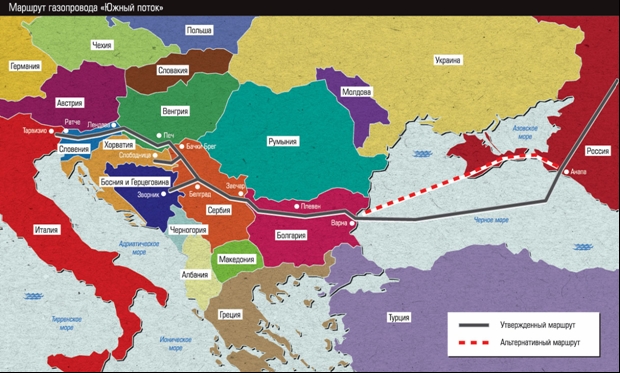
Chart 1. Crimean route of “South Stream”
http://m.expert.ru/data/public/459760/459783/025_expert_15.jpg
The source believes that a thesis about complexity of contracts renegotiation with Gazprom’s foreign partners, “who finance part of the project", could be considered insolvent. The partners would like to have reduce the payback period of their investments to halve the costs calculated by the proportional scheme. Another thing is that now, amid a wave of Russo-phobia, their political elites will not allow them to do this ".
Another indicative Russian comment to promote "Crimean route" is as follows: "Annexation of the Crimea for "South Stream" means that the project can be changed by reducing the underwater section by 220 km, besides the whole route of the gas pipeline will be laid in shallow water... The benefits of changing the route is so important that the geopolitical aspects of the Crimean crisis fade beneath the economic benefits to the project participants."
These estimates are more than doubtful, based on the understanding of Gazprom’s traditional practice – the finance plan of any project always increases, despite measures to reduce it. However, this speculative argument was used as bait for the Europeans, for whom it should be obvious that the route in the shallow shelf (up to 150 m depth) is more economical viable than the deep-water one (about 2000 m and more), as illustrated by the chart 2.
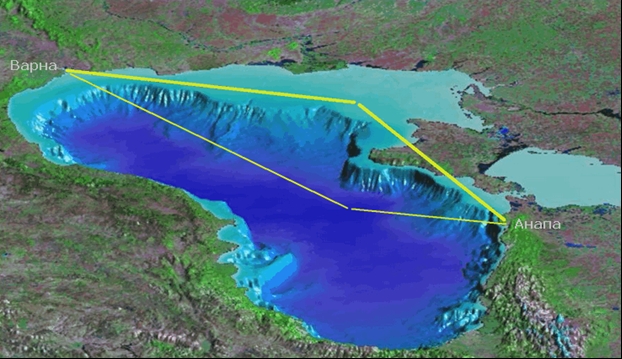
Chart 2. Crimean route of South Stream
http://www.profi-forex.org/system/user_files/Images/News/03-2014/260314/5201067.gif
Based on this information, as well as on data from our foreign sources, we can draw the following conclusions.
1. Indirect, but public recognition of the existence of "Crimean route" of “South Stream” confirms the previously expressed our version of the Kremlin’s plan for the recognition of the Russian status of the Crimea in the de facto regime, through the consent of the European partner companies for laying a pipeline across the peninsula. The abovementioned plan has failed; however, this does not mean that the Kremlin finally abandoned it. Moscow just takes a break in order to "treat the political elites in some EU countries."
2. Gazprom’s end run consists in influencing the business and political environment in a number of EU countries. A key role have to be played by Austria. It has been associated with the sudden June Vladimir Putin's visit to Vienna. It was the first successful result of the rapid "processing" of the Austrian elite. If we look at the chart 1, we will see that it reflects the realities of "previous Austrian period" because there is no branch to Austria. The emergence or rather the restoration of the route, where Baumgarten is the endpoint, indicates that there was held an agreement -"support of Vienna in exchange for price discounts of Moscow". This resulted in periodic statements of OMV on the need to build "South Stream". The last one is dated 4 August: "economic sanctions against Russia implemented by the European Union will not be an obstacle to the construction of the South Stream pipeline. Thus, Austria has been "bought in bulk" and would help Russia to resolve, among other things, the issue of excluding the "South Stream" from the Third Energy Package.
3. The idea of OMV and "Gazprom" is as follows:
3.1. OMV proposed an option of ersatz-study of "South Stream" exclusion from the Third Energy Package. According to the proposed scenario, not only the Russian gas will enter in the "South Stream", but gas from OMV, which would be extracted in the Romanian sector of the Black Sea shelf. From a formal point of view, this argument might work, but in fact, the volume of gas that could be extracted within the OMV share in the consortium will be miserable - several hundred million cubic meters per year.
3.2. Entrance of the gas produced by OMV to "South Stream" is possible in three ways:
- Through the construction of the feeding gas pipeline through the Romanian sector to Varna, Bulgaria with the further connecting pipeline to "South Stream";
- Through a change in the route of South Stream, with its passage through the Crimea and the shallow shelf of the Black Sea through the Romanian sector to Varna;
- Through a radical change in the route of the other branches of the "South Stream" - with paving it through Romanian but not trough Bulgarian territory.
4. According to its strategic plan, Austria plays the role of the active lobbyist for the "South Stream" in the EU, Germany provides a passive support, Russia will provide business preferences through opaque mechanisms described in the article "The victory of gazocracy over democracy or on the Russian flows of the European gas corruption"http://geostrategy.org.ua/ua/analitika/item/510-peremoga-gazokratiyi-nad-demokratieyu-abo-pro-rosiyski-potoki-evropeyskoyi-gazovoyi-koruptsiyi
The head of Austria's OMV Gerhard Roiss believes that the confrontation between the West and Russia on the background of the situation in Ukraine should not affect the planned construction of the "South Stream". In the context of G.Roiss’ "fidelity" to"Gazprom", a demonstrative fact is that he rejected the possibility of reverse gas supply from OMV to Ukraine.
5. The essence of the idea is that the Russian-Austrian-German co-operation should lead to the appearance of the effect of the circle gas supplies from Russia to Europe. Austria will perform this circle through the construction of a TGL gas pipeline, which effectively would bind both Russian streams. Thus, in Europe the gas circuit will occur, where only Russian gas will circulate with a meager admixture of OMV’s gas from the Romanian Black Sea shelf. By this way, "Gazprom" plans to save a monopoly of its supplies from the East to the EU.
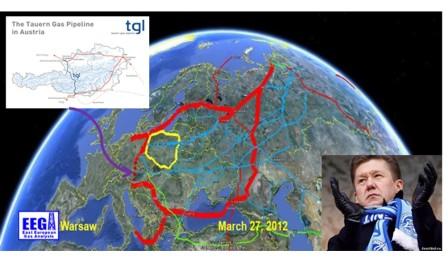
Chart 3. Russian “gas circle” for Europe
5. It is significant that on August 23 the German Vice-Chancellor Sigmar Gabriel made a statement that "he almost did not see the opportunities for the return of the Crimea to Ukraine." This approach was somewhat disavowed by Angela Merkel during her visit to Kiev. Nevertheless, the position of the Vice-Chancellor, who is a key figure in the decision-making in the field of economy and energy, is quite remarkable. One should not have illusions about Merkel herself. German Chancellor, after returning from Kiev, according to ARD, said: "The Ukrainian people, of course, should be able to choose its own path," adding, "it (Ukrainian action) should not harm Russia", that is, to harm the present ruling coalition in Berlin - "Rußland über alles". However, it would be wrong to argue, that such an approach is dominant in German society. Even the Russian media were forced to regret that "it was enough to the head of Siemens to have an ordinary business meeting with President Putin, in order to experience in Germany the harsh criticism and accusations that he had no conscience and even betrayed the motherland." Thus, the German society is more adequate in their perception of Russia and European values than German political circles and big business, lured by Kremlin’s "corrupt dealings".
6. Personal factor plays an important role not only in authoritarian countries, but also in those who consider themselves democratic. Abovementioned Sigmar Gabriel is a “parteigenosse” of Gerhard Schroeder and Frank-Walter Steinmeier at the SPD, traditionally forming the pro-Russian stance of Berlin. It is possible that the expected early departure of Angela Merkel will lead to further pro-Russian drift of Berlin. April statements of S. Gabriel are demonstrative: "Discussions about gas supplies for Europe should not be held under the slogan of preventing any pipelines that start in Russia." It is also significant that the economic unit of the German government authorized the sale of mining assets - RWE Dea AG to Russian private investor; although just in June, the deal has been blocked yet.
7. The approach described above suggests that in the EU as a whole, and in Germany in particular, there is no understanding of the deep essence of Russia's energy policy, which is not merely to sell gas at high prices in Europe, but also an instrument of foreign policy. In Ukraine, the political leadership has not yet realized the extent of the danger posed by the German policy, focused on Moscow. In fact, Kremlin’s aggressive regime has been nurtured with the European money for Russian hydrocarbons. In addition, German money played a key role in this, as Germany is the largest consumer of Siberian gas, oil and oil products. For German elite it is difficult to accept the fact that politics in Berlin towards Russia is unworkable and led to the outbreak of war on the continent. "Flawless democrat" Putin, as Schroeder described him at the time, has appeared to be a Hitlerite figure, and the policy of Russia seems to be neo-Soviet revanchism.
8. In the"Ukrainian question" German policy is almost incentive for the Kremlin, despite the imposed limited sanctions. According to the chairman of the Bundestag Foreign Affairs Committee N. Rettgen, the "direct intervention of Russian troops in Ukraine would become the escalation of the situation, but the West would not respond to this by military means." Earlier the German minister of foreign affairs had refused to support Ukraine with military means. This is exactly what the Kremlin needs in order to continue the escalating scenario in Ukraine, to show further that Ukraine is a failed state that cannot provide security, including, and transit of gas to Europe. Therefore, according to the Kremlin’s logic, nothing else remains to do for the EU but to accept the construction of the "South Stream". Herewith, Gazprom together with its partners will be ready to optimize the pipeline’s route. The "pragmatic" minded Austrians, the Germans, the Italians, the French, of course, would support the "Crimean correction" of the route, waiting for gas flows from Russia and for money from the Zug canton, where the offices of the South and Nord Stream are situated.
9. Taking into account searching-for-revenue psychology of the European political elites, Russia invites them to large-scale "bribe-via-discount" - reduction of prices of gas supplied to the EU. Of course, all of this is disguised in respect with the reality of energy markets, although this reality has not arisen today, but already in 2012. Estimated dynamics of prices reduction is as follows:
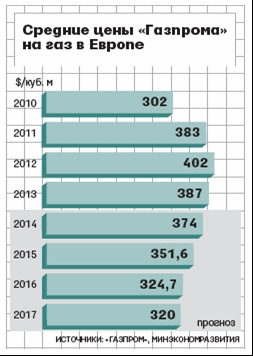
http://www.vedomosti.ru/companies/news/28854191/gazpromu-pora-ekonomit
In fact, the amount of “bribe-via-discount” could be much higher. Last year, for instance, Gazprom Schweiz AG offered gas in Europe with $290 for 1000 m3.
Therefore, it is clear, why annexation of Crimea is becoming more and more an omission issue in rhetoric of leading political elites in the EU, while the “South Stream” project takes more dynamics in the circles of the big business and political lobby, despite opposing approach of the European Commission. A price for such efforts are the billions of euro, waiting for participants of this “gas game” in silent Swiss cantons of Zug and Zurich. It is therefore no surprise, that Gazprom demonstratively ignores not only the European Commission, but also the current temporary Bulgarian government with the explanation of “future talks after elections (October 5, 2014). Similar approach will be introduced, according to Kremlin’s logic, towards new European Commission with the aim to get approval for “South Stream” under pressure from governments of the member-states. Even deceived Slovenia, still waiting on a billion of Gazprom’s investment, will take the Russian side.
***
In December 2013, in our analysis we have stated “if the EU, U.S. and NATO would fail to implement policy of containment against Russia (not only in Ukrainian issue), it would result in a new war in Europe already in 2014”.
http://geostrategy.org.ua/ua/analitika/item/253-ekspress-analiz-potochnoyi-situatsiyi-v-ukrayini-ta-navkolo-#5-16-grudnya&Itemid=146
The war is going on almost half a year, but Europe continues to stay in its parallel reality and is not able to understand, that the war of the Moscow tsar against Ukraine is the war against Europe too. Europe fails to understand yet that if not this year, than next year the war will come on the territory of one member-state of the EU and NATO. Kremlin’s logic is very simple – if it is not stopped, it will go further. It considers sanctions not as an obstacle and is sure that West will not wage the military counteractions, given inability even to large-scale economic sanctions. Oil and gas are excluded from sanction list; “South Stream” is not refused but only postponed; there is no consolidated position of the EU and Ukraine, the issue of Crimea annexation went out from the agenda. Reactions on shootings on Ukraine’s territory, continuing weapons and diversionists supplies from the Russian side to the east of Ukraine are in the framework of “concerned – deeply concerned” from the West. LNR and DNR are not recognized as terrorist organizations. Downing of the Malaysian Boing is not in the spotlight, the EU and NATO do not consider supporting Ukraine by military means. All abovementioned is estimated by Russia as success of the last period. Kremlin is concerned only by U.S position, which are “slowly getting down to”…
It is highly possible, that during announced negotiations in the framework Russia – the EU (Novak – Oettinger) on 29 August, Russia would push forward with “South Stream” by blackmailing Brussels with “Ukrainian crisis” and anomalously “cold winter 2014/2015”. It could also try to use “punitive measures” by reducing gas supply to those EU countries, which reverse Russian gas (Putin threatened by such measures after Normandy). The occasion could be a start of reverse gas supply from Slovakia on 1 September. Moscow would press out from Brussels its positive decision on “South Stream” both by carrot and stick motivation. It is not occasionally, that military conflict in the east of Ukraine has once against escalated. In order to destroy Russian game, the President of Ukraine should not agree to the deal “Crimea in exchange for gas”, even if German “friends” are strongly favoring it, especially by preparing ground for it during a meeting in Minsk on 26 August and bilateral EU – Russia meeting in Moscow on 29 August. Such a deal would mean not only “Crimean route” of “South Stream”, but also further escalation of Russian invasion in Ukraine, because Kremlin would receive an evident of success of its uncompromising hybrid (by corruption and force) strategy to press out for necessary decisions, even if with some delays, but in the long run with desired outputs. It is also evident, that even negotiations about possibility of such a deal would means a political catastrophe for the President of Ukraine.


