


Participants of the conference discussed sources and character of the Russian neo-imperialism at the current stage, forms and methods of its influence on the countries of South East Europe, negative consequences for the region and ways to counter and neutralise them with the aim of development, peace, security and regional stability.
While opening the discussion, President of the Centre for Global Studies “Strategy XXI” Mykhailo Gonchar underlined that it was important that the conference took place in Odesa, where extension of “Russkiy mir” was stopped in 2014, and attempts of the Russian Federation to destabilize the Odesa region are opposed even today. According to him, the essence of the neo-imperialist approach of Russia lies in actions from inside of the countries of the region and promotion of recognition of these countries by the EU as an area “in between”. Head of the Konrad Adenauer Stiftung Office in Ukraine Gabriele Baumann said that numerous experts concluded that the Russian destabilisation policy was extended not only to Ukraine but also to Southern Caucasus, the Balkans, the Black Sea region and the European Union. She noted the lack of information on Russian influence in Crimea in the EU countries, where citizens were more aware of the problems of the Crimean Tatars. In his turn, Head of the International Programs of the Centre for Global Studies “Strategy XXI” Vitalii Martyniuk suggested that the region of South East Europe looked like a mechanism that should unite all peoples in order to make it stable, peaceful and prosperous.
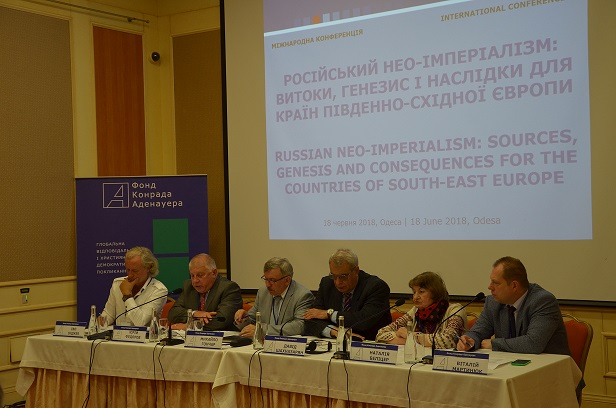
The participants of the 1st discussion panel focused on sources and genesis of the Russian neo-imperialism, Thus, Mykhailo Gonchar stressed that its strategic conception provided that the European Union would become a high-tech appendage for Russia, and the countries of South East Europe would be under full control of the Russian Federation. According to him, in Europe, Russia poses threats of hybrid character, which are not considered as threats, and the Nord Stream 2 is one of these high toxic threats that will have destructive consequences for the European unity. Therefore, only consolidation of efforts through creating an expert network of early reaction in the region will prevent the Russian Federation from implementing its neo-imperialist policy.
Yury Fedorov, Russian Military-Political Expert, noted that Russia’s hybrid war against Ukraine became only the first stage of the global strategy of the Russian Federation, targeting the EU and the international architecture. Russian neo-imperialism assumes two aspects: bringing pro-Russian forces into power in the countries of South East Europe; creation of a belt of states of the region under the Russian protectorate for further Russian expansion in Europe. Therefore, in order to counter Russia's expansion, in addition to the NATO defence system, a regional security system with Ukraine in the core should be established.
Expert of the Pylyp Orlyk Institute for Democracy, Natalya Belitser reminded of Russia's massive violations of human rights in the occupied Crimea and stressed the shift of attention of the international community from violation of human rights to the FIFA World Cup in Russia. As an effective way to counter this, she suggested to accelerate corresponding lawsuits against the Russian Federation in the international courts.
Chairman of the Center for Legal and Political Studies "Concord" (Armenia) David Shahnazaryan said that the West, the EU and the US, had always underestimated the threat of the Russian imperialism, which had always been in Russia but entered recently its active phase. He drew attention to the use of corruption by Russia for its hybrid war that was aimed at undermining the countries from inside. Corruption became a huge threat to the European security like international terrorism.
In the same context, Bulgarian journalist and blogger Ivo Indzheev called Bulgaria an excellent example of the use of corruption by Russia, especially in the energy sector. Herewith, Bulgaria does not resist Russian aggression, and there is no political party in the country that would criticise Russia, turning Bulgaria into a "Trojan horse" inside the EU.
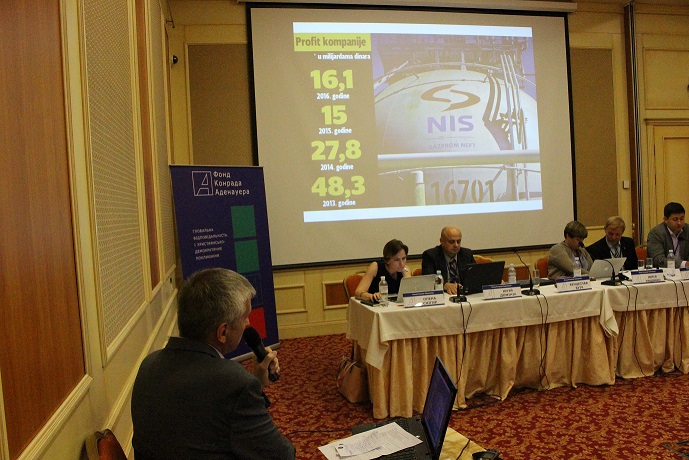
At the 2nd expert panel, key negative consequences and threats of Russia's neo-imperialism to South East Europe were outlined. Commander of the Ukrainian Navy (2014-2016), Head of the Association of Veterans of the Naval Forces of Ukraine, Vice Admiral Serhii Gayduk noted that the current activities of the Russian Federation in the Black Sea and Azov region were aimed at strengthening its own military presence by militarizing the Crimean peninsula and isolating Ukraine from the sea. Therefore, Ukraine must quickly restore its capable marine component of the country's defence system, which requires a systematic approach, a strategy for restoration of national sovereignty at sea, development of a maritime policy of the state and involvement of all economic, political, diplomatic and military resources of the country.
Yulia Tyshchenko, Head of the Democratic Processes Support Program, Ukrainian Center for Independent Political Research, drew attention to the fact that the militarization of Crimea also included "militarization" of civilian life there, which was one of other negative impacts, such as replacement of the Crimean Tatar and Ukrainian culture and traditions by the imposed Russian culture and traditions.
Following its imperial policy towards Moldova, as National Security and Defence Expert from Moldova Iurie Dominic noted, Russia relies on Transnistria, the "fifth column" and corruption. However, Moldova made conclusions from Russia's aggression against Ukraine, introduced changes to its national security legislation, and took measures to counter Russian propaganda through imposing restrictions on the possession of television channels (no more than two) by one person and banning the broadcast of the TV channel “Russia 24”.
Director of Serbian - Euro-Atlantic Cooperation Vencislav Bujic called the use of pro-Russian forces, propaganda and energy tools by Russia to strengthen its influence in Serbia extremely dangerous for the region and Europe as a whole. In order to counteract such an impact, he proposed strengthening a campaign to inform the population in Serbia and other Western Balkan countries about what was really happening in Ukraine.
Summing up the discussion of the panel, Senior Specialist of the Center for International Studies of the Hennadii Udovenko Diplomatic Academy of Ukraine at the Ministry of Foreign Affairs of Ukraine Olena Snigyr noted that Russia was moving forward very carefully and used only weaknesses, imposing an illusion to objects of aggression that nothing terrible happened and nothing changed. It also proficiently used its privileges as a permanent member of the UN Security Council for the implementation of its neo-imperialist policy in the world.
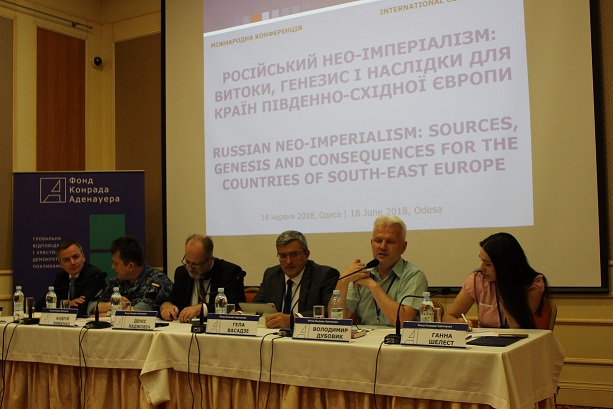
The participants of the 3rd expert panel focused on ways of counteracting Russian neo-imperialism in the region of South East Europe. Thus, Director of the Center for International Studies at the Odessa Mechnikov National University Volodymyr Dubovyk noted the need for the countries of the region, the EU and NATO to more clearly define their regional policies in South East Europe not to allow Russia to use this vacuum for extension of its negative impact on the security situation in the region.
In his turn, Leader of the program "Big Game" (Georgia) Gela Vasadze offered to use the anti-Russian consensus of the elites in the Post-Soviet countries to prevent Russia from transforming the region into a peculiar buffer, while Ukraine would become the centre of gravity for the Post-Soviet space and create an alternative to the "Russkiy mir", proposed by Moscow. He also called on experts and journalists from the Eastern Partnership countries, as well as Turkey, Iran and the Central Asian states, which had many common issues, to join in counteracting Russian imperialism.
Director of the Centre for Security Studies (Bosnia and Herzegovina) Denis Hadzovic noted that Serbia and Bosnia and Herzegovina, through its entity - the Republika Srpska, were the most vulnerable to Russian influence among the countries of the Western Balkans. On his opinion, the European Union must harder implement the decision of the EU - Western Balkans Summit, held in 2003 in Thessaloniki, which defined the EU membership for all the countries of the region.
Andrii Ryzhenko, Deputy Chief of Staff of the Navy Command of the Armed Forces of Ukraine on Euro-Atlantic Integration, drew attention to the importance of strengthening Ukraine's defence capabilities at sea, which should prevent Russia's domination and, accordingly, strengthen security in the Black Sea region. Otherwise, Russia will threaten all the countries of Europe and the Mediterranean by its ever-increasing military presence in Crimea.
According to Alexander Khara, Foreign policy and security expert, Deputy Chair of the Black Sea Institute of Strategic Studies, countering to the Russian neo-imperialism goes through internal transformation, reforms, economic development and fight against corruption in all countries of South East Europe. In addition, on his opinion, it is worth to develop public and expert diplomacy and intensify formats of interstate cooperation, which already exists in the region.
One of the most important results of the international conference in Odesa is the development of cooperation between think tanks and NGOs in South East Europe, which is aimed at counteracting negative impacts of the Russian neo-imperialist policy and promoting prosperity, peace and security in the region.


