


The pipeline project "Nord stream-2" from Russia to Germany, bypassing Ukraine and Poland, has caused the indignation of Kyiv and Warsaw. "Poland and Ukraine are concerned above all by the reduction of fees for gas transit", - explained the head of the German energy group Wintershall Mario Mehren in an interview with Handelsblatt, published on April, 7.
The new branch will double the capacity of the laid along the bottom of the Baltic sea gas pipeline from 55 to 110 billion cubic meters per year. According to many experts, it will make unnecessary the transit of Russian gas to Europe through Poland and Ukraine. The head of the concern Wintershall, which participates in the project together with "Gazprom", does not think it is necessary to consider the concerns of these countries. "Gas transportation is not a contribution to fiscal consolidation in third countries," Meren said.
However, the prospect of losing two billion euros - that's how much every year Ukraine receives from Russia for pumping gas - is not the only reason of the indignation of Kyiv by "Nord stream-2".
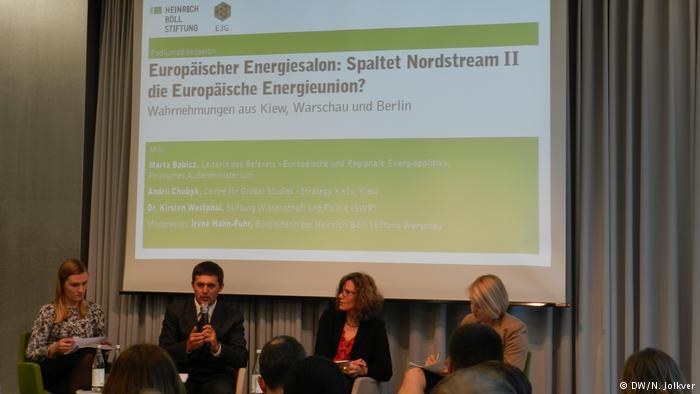
Discussion at the Heinrich Böll Foundation concerning the "Nord stream-2"
The money is not the main thing?
The expert of the Ukrainian Centre for Global Studies "Strategy XXI" Andrii Chubyk believes money is not the main reason: "We will survive even without these two billions, we had more difficult times." According to him, the main issue is the technical balance of the gas transportation system. We say both about internal pumping gas between producers and consumers, and about transit, not only to the EU but also to Moldova, Turkey and the Balkans.
"It would be very difficult to maintain such an interconnected system in working condition if the level of transit will be reduced, for example, to 20 billion cubic meters per year" - Chubyk said in an interview with DW. If gas transit from Russia to the EU through Ukraine will be stopped, he continues, then one part of the "pipe" will be put on conservation, another part will be demounted. Accordingly, Ukraine will be excluded from the integrated European gas system and will work autonomously.
"It is being decided now, - Chubyk says. - "Ukrtransgaz" began to carry out technical assessment of the relevant decisions, to outline what and where it will be necessary to close the pumping stations, which pipes will be conserved". The main problem, he said, is that "in the EU no one calculates how it will affect other markets."
The political project of the Kremlin
Kyiv and Warsaw are convinced that "Gazprom" fulfils by this projectthe the political will of the Kremlin to strengthen Russia's domination on the European gas market, to destabilize Ukraine and to split the European Union.
These thoughts came during a debate on the "Nord stream-2" in Berlin. The discussion was attended by Marta Babicz, the head of the essay "European and regional energy policy", from the Polish Foreign Ministry, by the expert of the Berlin Foundation "Science and Politics" (SWP) Kirsten Westphal, and by Andrii Chubyk, who came to Berlin at the invitation of the German Heinrich Böll Stiftung.
Marta Babicz pointed to the prospect of almost total dependence - in the future - of Germany on the only gas supplier and the only route through the Baltic sea. According to her, the new Gazprom's project contradicts also to the EU policy towards Ukraine. She argues that Brussels, on the one hand, provides financial assistance to Kyiv, and on the other is reconciled with the future loss of gas transit revenues by Ukraine.
From a purely economic point of view - Babicz adds - "Nord Stream-2" is not logical. According to the forecast of the European Commission, gas consumption will decrease in the EU due to energy efficiency and alternative energy development. And now, according to her, about 40 percent of the existing gas transportation infrastructure from Russia to Europe stand idle.
If the demand increases contrary to the predictions, the modernization of the Ukrainian gas transportation system would be significantly cheaper than laying two more pipelines through the Baltic sea, Babicz indicates.
What's in the best interest of Berlin?
Both Chubyk, and Babicz urged the German government during the discussion to use its influence to prevent the implementation of the "Nord Stream-2".
Kirsten Westphal from SWP argued: Germany is a rule-of-law state and the government cannot change the legal rules of the game for political reasons. "I don't see any of the existing legal instruments, which would help to stop the project "Nord Stream-2 ," Westphal said in an interview DW. "Even under all political counter-arguments I believe it is important to maintain economic ties with Russia," she explains. However, Westphal also puts into question the economic feasibility of the project. According to her, it's now hard to say what Europe's demand for gas will be, what measures for climate protection will be taken, how alternative energy will be developed, which funds the modernization of the Ukrainian transit will require.
"Nord Stream-2" was mentioned for the first time in 2015. The time to expand the German-Russian trade relations soon after the annexation of the Crimea and in the midst of the fighting in the Donbas was not suitable.
Representatives of the German government were critical about these plans then. Now the official position of Berlin is following: it is a purely commercial project, which, of course, must obey German and European norms, but only members of the consortium can take decisions. The official representative of the Federal Ministry for Economic Affairs and Energy of Germany Beate Baron answered so on the question of DW.
According to Kirsten Westphal's assessments, the German Government uses double strategy for Russia. Maintaining the sanctions regime against Russia, Berlin puts further pressure on Moscow in response to its threat to European security, but tries therewith not to overreact and not to drive the Kremlin to a standstill. Germany, as Westphal notes, is interested in peace and stability, including in Russia itself, which needs revenues from energy exports, so the torpedoing of "Nord Stream-2" is not in interest of Berlin.
Authors Mykyta Zholkver, Stas Sokolov


