


Well, the current ruling party – GERB ("Citizens for European Development of Bulgaria") - unexpectedly lost the presidential elections in November 2016. They were won by the Socialists Rumen Radêv who claimed about the harmfulness of sanctions against Russia.
It is worth reminding here that this win (as well as Igor Dodon's in Moldova) looked like the beginning of a trend of coming to power of pro-Russian politicians in Europe. Were these fears premature?
Although the new President of Bulgaria has refrained from pro-Russian statements in recent months, it could be changed just after the parliamentary elections.
After all, Bulgaria is a parliamentary state, where the power belongs to the government.
But we can say looking at election results that "Russian revenge" will not happen. After 97,17% of votes were counted, the GERB is gaining 32,63% and its main opponent – the Bulgarian socialist party (BSP) – 27,1%.
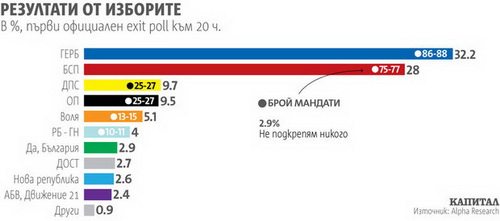
However, preliminary results show that the internal political crisis rather worsened, but not resolved by elections, and still may add more troubles to the already unstable European Union.
Full article can be read in Ukrainian here.


