


On the first day of the conference, over 70 participants, including representatives of foreign diplomatic missions, international experts, attended a round table.
At the first panel, questions for discussion were: Eastern European security in the new NATO-EU cooperation formats, NATO-Ukraine cooperation on energy security, strategic communications, cybersecurity as a key dimension of EU common defense policy, Russia's influence on the European security in the context of the Euro-Atlantic integration of Ukraine.
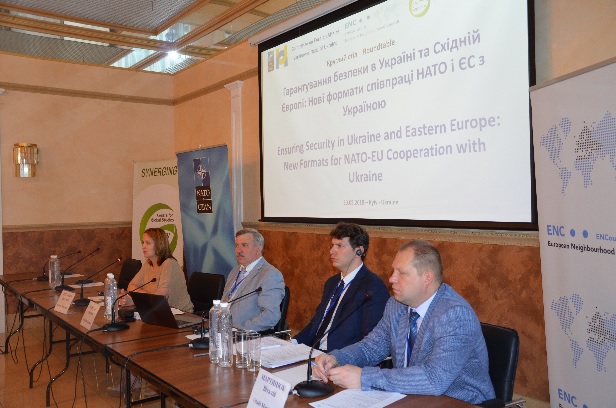
In the opening speech, Svitlana Rotayenko, Programme Officer of the NATO Information and Documentation Center in Ukraine, noted timeliness of this event, because the NATO-EU cooperation in the field of security is very actual, especially in light of the coming NATO Summit in Brussels. President of the Centre for Global Studies Strategy XXI Mykhailo Gonchar emphasized importance of finalization of the process of joining Ukraine to the NATO Energy Security Centre of Excellence in Vilnius, Lithuania and transferring this practice to the NATO Strategic Communications Centre of Excellence in Riga, Latvia and NATO Cooperative Cyber Defence Centre of Excellence in Tallinn, Estonia.
Samuel Doveri Vesterbye, Managing Director of the European Neighbourhood Council, in his speech emphasized the need for better communication between ministries and departments of the NATO and the EU countries with Ukraine. He considers apathy of citizens as the cause of threats in societies. Therefore, information campaigns are of great importance in deepening the dialogue between citizens and the EU, as well as involving society in monitoring of the events taking place in the country.
Oleksii Genchev, Head of NATO Section of the Government Office for European and Euro-Atlantic Integration of Ukraine highlighted the issues of staffing of ministries and departments by specialists specializing in Euro-Atlantic integration before 2014: "In 2014, the departments responsible for Euro-Atlantic integration was completely destroyed by the previous government: approximately 100 people worked in this area in Ukraine." In his speech, he also focused on Ukraine's procedural cooperation with NATO: "The annual national program is the roadmap for our reforms, and in NATO this document is read much more carefully than in Ukraine ... NATO is ready to engage Ukraine not only at the donor-beneficiary level, but as equal partners ". He called the protection of critical infrastructure and strategic communications one of the key areas of cooperation, but the latter should be perceived in Ukraine not as a PR, but as a strategic planning.
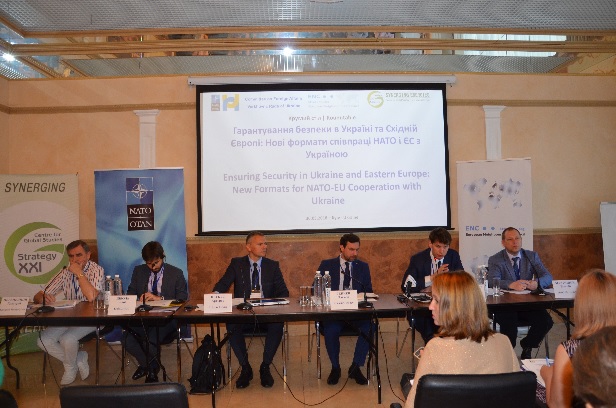
Arturas Petkus, Head of Strategic Analysis and Research Division, NATO Energy Security Centre of Excellence, in his speech also emphasized the protection of objects of critical energy infrastructure. On this occasion, NATO Energy Security Centre of Excellence became co-organizer of Coherent Resilience 2017 training in 2017 in Kyiv, involving 76 participants from various institutions of Ukraine, in particular Ukrainian companies Ukrenergo and Energoatom, and representatives of security institutions. Therefore, A. Petkus considers the issue of stability of critical infrastructure in the context of hybrid threats to be important one.
Elois Divol, a policy officer of the Cyber Policy Coordination, Conflict Prevention & Security Policy department of the European External Action Service noted the need to develop cybersecurity capabilities. In September 2017, the European Commission updated its cybersecurity package on the basis of already existing instruments and new initiatives to strengthen EU cyber-security, which should be taken into account by Ukraine. Among the priority issues, he highlighted the issue of software certification, the process of reporting, and the introduction of standards of responsibility for actions in cyberspace. It was emphasized that the framework strategy for cooperation in cyberspace should be applied globally, and cyber security measures should be well coordinated.
Grygorii Perepelytsia, Director of the Foreign Policy Research Institute, stressed the inadequacy of perceptions of threats by the West. During the discussion, he raised the main question if NATO could now return to the function of collective defense, taking into account the threats hanging over Eastern Europe, and in particular the Baltic states from Russia with its second-largest army in the world.
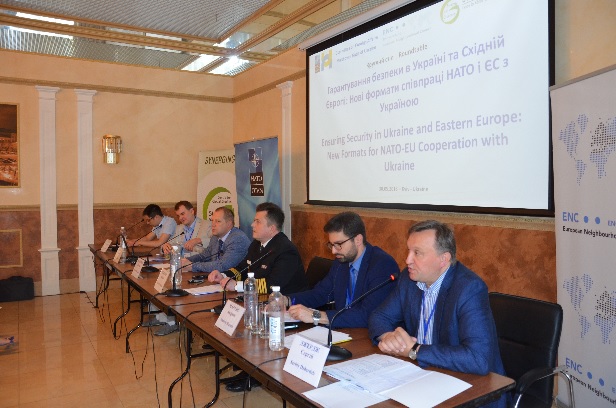
Andreas Marazis, Head Researcher for Eastern Europe & Central Asia in European Neighbourhood Council, stressed the importance of joint work between NATO, the EU and Ukraine on security domain, in particular, he said "that there is potential of an increased EU-NATO cooperation in relation to Ukraine in the fields of cyber security and strategic communication, with the objective of further embedding the country’s security." A. Marazis noted the importance of already implemented trainings and courses that facilitate the exchange of experience between EU/NATO specialists and Ukrainians.
Serhiy Dzherdzh, Head of Coordination Council of the NATO-Ukraine Civic League, has analyzed the modern embryonic processes of creating a separate army of the EU, taking into account the interest of Europeans to have a security configuration that will be influenced by the EU. In this context, he said: "It is very important that the EU and NATO have a joint assessment of the situation, which will provide a common understanding of the threats, and in turn will make it possible to formulate a common goal." As he mentioned, signing by powerful European firms of large contracts with Russia is a signal for the Russian population that Russia is respected at the international arena, so there is no potential among the population to face Russian authoritarian regime.
Andrii Ryzhenko, Deputy Chief of Staff of the Navy Command of the Armed Forces of Ukraine on Euro-Atlantic Integration in his report noted that security in the Black Sea region was severely violated after the Crimean occupation of Russia. The situation requires assistance from partners, because in the Black Sea area, Russia has deployed powerful combat capacities: "There are currently six submarines in the Black Sea area, which can carry nuclear warfare". In his opinion, this requires increased cooperation both within Ukraine, between all governmental and non-governmental structures, and between NATO, the EU and Ukraine on strengthening security in the Black Sea. An example of such cooperation is the preparation of a new Ukrainian Navy Development Strategy - 2035.
Vitalii Martyniuk, Head of the International Programs of the Centre for Global Studies Strategy XXI, in his report mentioned the following: "The balance in Europe was violated after the occupation of the Donbas. Awareness of these changes has been reflected in the EU and NATO. " In December 2016, NATO and the EU identified 42 measures that they pledged to cooperate jointly in the framework of security cooperation, and in December 2017, these measures were further extended to three new areas - counterterrorism, military mobility and the role of women in the defense sector. The counteraction to hybrid threats, to which Ukraine needs to be fully integrated, lies in the focus of such cooperation. Therefore, the dual purpose of Ukraine - membership in NATO and the EU - is fully correlated with the vision of strengthening this cooperation.
Maksym Khylko, Chairman of the board of the East European Security Research Initiative Foundation in his speech noted that the greatest threat in the region is the aggressive policy of Russia, which has various manifestations. Therefore, responses to hybrid aggression should be diverse. Taking into account the bureaucratic procedures of the EU and NATO, in his opinion, the legal basis for Euro-Atlantic integration of Ukraine is necessary. In the context of combating hybrid threats, the speaker noted the importance of the full functioning of the NATO-Ukraine Platform for Combating Hybrid Threats.
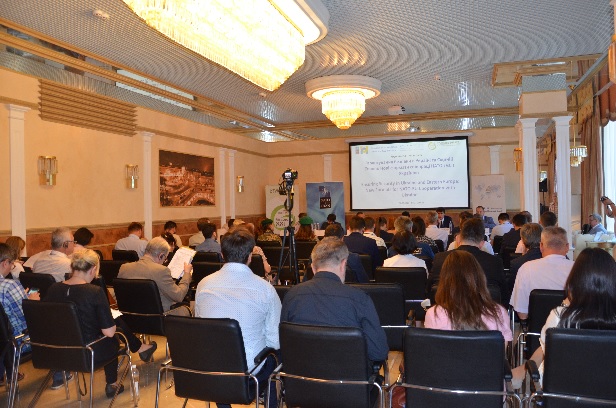
Volodymyr Solovian, Head of the Foreign Policy Projects in the Centre for Army, Conversion and Disarmament Studies noted that the Alliance remains an organization that prepares itself for peace, not for war. The case of the process of creating the obstacles in the work of the NATO-Ukraine Commission by Hungary under the pretext of a language issue has demonstrated that the leadership of the Alliance does not have the tools to coerce an individual member to act adequately. According to the speaker, in September 2016, Ukraine applied for membership in the NATO Enhanced Opportunities Partnership, which, in the event of a positive decision, will provide opportunity for exchange of information, greater experience in conducting exercises, and the ability of wider cooperation in the event of a crisis.
Summing up the discussion, Barbora Maronkova, Director of the NATO Information and Documentation Centre in Ukraine, stressed that Ukraine should combine European and Euro-Atlantic integration into one case, as at that time the countries of Central and Eastern Europe, which have already acquired membership in both the EU and NATO, did. Also, she considers important to focus first on integration into NATO, since this complex of internal reforms is smaller compared to the process of integration into the EU.
On the second day of the conference, the High level Discussion was held in the Verkhovna Rada of Ukraine under the “Chatham house” rules. Members of the Ukrainian Parliament, representatives of ministries, the Representation of NATO, the EU Delegation and diplomatic missions in Ukraine participated in the event.
While opening the discussion, Iryna Gerashchenko, First Deputy Chairman of the Verkhovna Rada of Ukraine, noted that Ukraine needed concrete support from international partners. Samuel Doveri Vesterbye, Managing Director of the European Neighbourhood Council, said that Europe faces new challenges like hybrid wars, propaganda and cyber-attacks. Mykhailo Gonchar, President of the Centre for Global Studies “Strategy XXI”, underlined importance of enhancing inter-institutional dialogue and deepening studies of existing problems of the cooperation between NATO, EU and Ukraine.
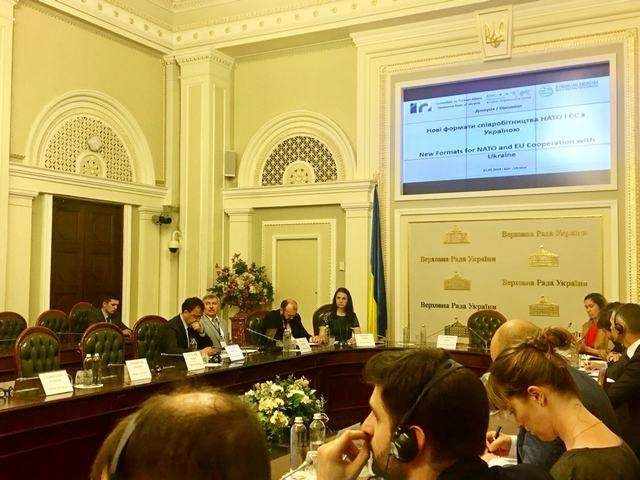
Vasyl Bodnar, Deputy Minister of Foreign Affairs of Ukraine, expressed the necessity to strengthen the NATO-EU-Ukraine cooperation and noted that NATO should demonstrate a clear and strong position with regard to Ukraine. This opinion was also supported by Barbora Maronkova, Director of the NATO Information and Documentation Centre in Ukraine. She spoke about specific opportunities and areas of cooperation with NATO. In his turn, Alexander Vinnikov, Head of the NATO Representation in Ukraine, noted that the security challenges for Ukraine and the entire Eastern Partnership region influenced the content of the NATO-EU cooperation.
Hanna Hopko, Chairperson of the Committee on Foreign Affairs of the Verkhovna Rada of Ukraine, emphasized the importance of continuing the reforms in the field of security and defense, in particular, adoption of the Law on National Security in accordance to the key NATO principles before the NATO Summit in July in Brussels. She called on the partners to continue their efforts to unblock the NATO-Ukraine Commission and demonstrate support to Ukraine, in particular by preventing the construction of the pipeline North Stream 2.