


While opening the conference, Mykhailo Gonchar, President of the Center for Global Studies “Strategy XXI”, stated that Europe began to wake up and pay attention to security in Eastern Europe, as evidenced by the signing of the Prague Declaration, which identifies seven necessary steps that the Democratic West must do to stop Russian aggression. In her turn, Gabriele Baumann, Head of the Konrad Adenauer Stiftung Office in Ukraine, stressed that an active exchange of views and information on security issues currently takes place between Ukraine and the countries of Eastern Europe. Germany, she said, is considered to be a guarantor of security in Eastern Europe, and the new government of Germany, which would be formed by the end of this year, will continue to support Ukraine, including security issues. Hanna Hopko, Chairman of the Committee on Foreign Affairs of the Verkhovna Rada of Ukraine, noted that the idea of a gradual refusal of the EU countries from Russian energy sources could become an effective instrument of deterring Russian aggression, but Europe is not ready to consider energy as an element of deterrence of the Kremlin.
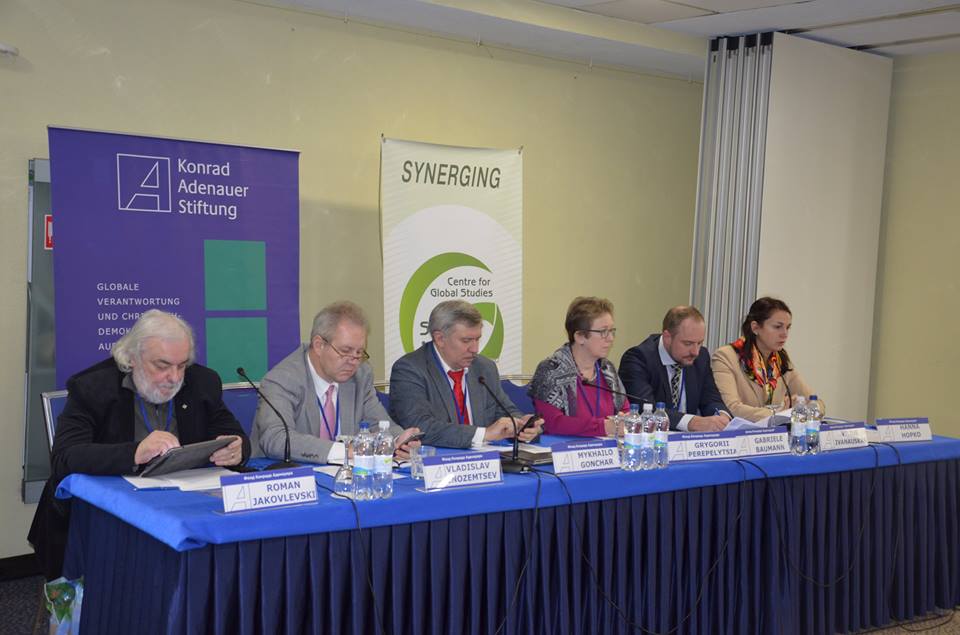
During the opening of the first panel devoted to the regional security in Eastern Europe after 2014 and the approaches of key regional players to it, moderator Grygorii Perepelytsia, Director of the Foreign Policy Research Institute, described the security dilemma of Eastern Europe in the 20th century, which is perceived as a buffer zone between East and West, where Russia has resorted to revanchist actions to restore its domination. Thus, Ukraine has been drawn into the war not only for its statehood, but also for European values.
Vladislav Inozemtsev, the Russian politologist, senior research fellow in the Polish Institute of Advanced Studies (Warsaw) stated that since the 90s, Russia has been the main provocateur of instability in Eastern Europe, which it perceives as a natural sphere of its interests, being the main initiator of conflicts in Transnistria, Georgia, South Ossetia and the Crimea. Ukraine is perceived as an "in between" zone, so it need to take a more proactive stance. According to the expert, Moldova's membership in the EU would be a strong signal for Moscow, and would contribute to resolving the conflict in Transnistria.
Roman Jakovlevski, a political observer from Belarus had submitted an analysis of Zapad-2017 Joint Strategic Exercise of Russia and Belarus; a possibility of appearance of the Russian missile base on the territory of Belarus, an analog to the military base of Gyumri (Armenia); the updated agreement on bilateral military cooperation between Russia and Belarus. According to the expert, bilateral relations between Ukraine and Belarus are currently unsatisfactory. Belarus used the test of the modernized multiple launch rocket system “Polonez” as a pressure on Mr. Poroshenko on the eve of his meeting with O.Lukashenko in Abu Dhabi. The expert did not rule out the possibility of using the Belarusian territory as a springboard for an offensive operation.
Vilius Ivanauskas, Chief policy analyst of the Eastern Europe Studies Centre (Lithuania), in his speech, focused on Russia's attempts to regain the status of a superpower. The expert expressed a fairly pessimistic view on Russia's ability to pursue a policy of global superpower.
Adrian Pop, Professor at the National University of Political Science and Public Administration (Romania), in his speech, analyzed the gradual militarization of Russia in the period from 2010 to 2016, as well as the regional conflicts, in particular the danger of defrosting the conflict in Nagorno-Karabakh in the summer of 2016.
In the report of Nika Chitadze, Director of the Black Sea Region Geopolitical Research Center (Georgia), the aspects of energy security in the Black Sea region were reflected, in particular the prospects of the TAP and TANAP projects realization, the peculiarities of the war in Georgia in 2008, the need for greater involvement of NATO in the Black Sea, and the need for a more sophisticated policy of Turkey.
Iurie Dominic, Brigadier General (ret.), security expert (Moldova), noted that the migration crisis in Europe led the perception of the security by the EU countries as a purely national problem. Regarding the unstable political situation in Moldova, he noted that some part of the population favored independent development of the country within the EU, while the other part was for joining Romania. The expert emphasized the need to build new military capabilities to protect Odessa and the Black Sea coast.
During the opening of the second panel devoted to security contribution of Ukraine in Eastern Europe, panel moderator Vitalii Martyniuk, Head of the International Programs at the Center for Global Studies "Strategy XXI" noted that the existence of a systemic security policy remains an uncertain issue for the Eastern European region.
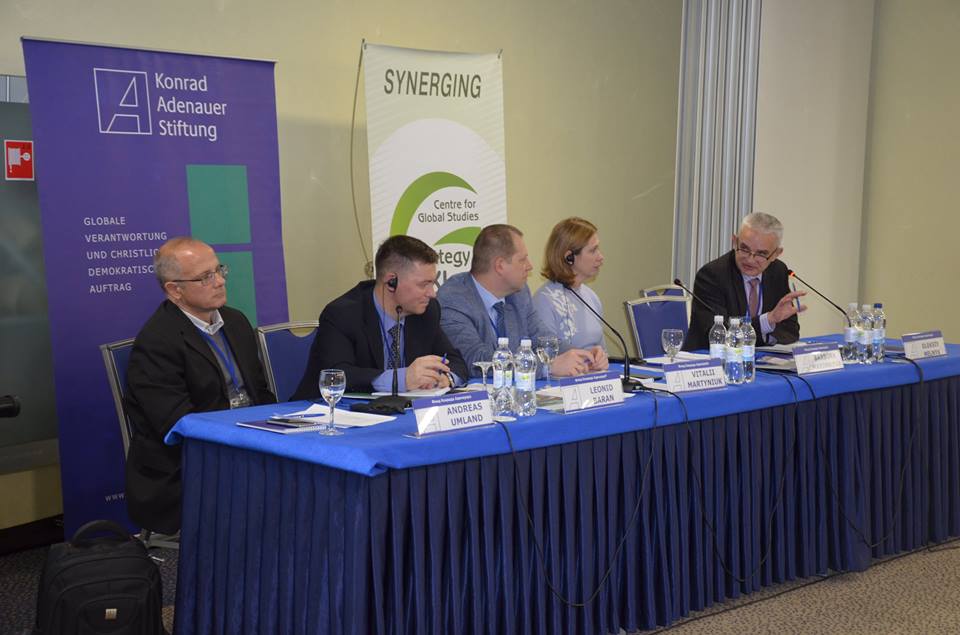
In her report, Barbora Maronkova, Director of the NATO Information and Documentation Centre in Ukraine, made a remark that Transatlantic security was closely linked to Ukraine's security, and the events of 2014 led to a revision of NATO's priorities, the strengthening of its eastern flank and increased NATO spending on defense to 2% of GDP. After the summit in Warsaw in 2016, the cyber security was officially recognized as the fifth domain of operations, which gave a separate impetus to the development of this direction in counteraction to Russia's aggression.
Andreas Umland, Senior Fellow of the Institute for Euro-Atlantic Cooperation (Kyiv), in his speech touched the prospects of Ukraine's accession to NATO, which, in particular, were outlined during the Bucharest summit in 2008 and assessed by the expert as declarative. NATO enlargement at the expense of the Baltic States took place in a favorable period when Russia was not perceived as an enemy. At the same time, the expert expects Russia to weaken in the medium term over the next 10-20 years, to which Ukraine has to be prepared already today, taking into account China's economic growth and possible changes in the ruling elite in Russia due to natural reasons. The expert expressed doubts about the success of the Intermarium project and emphasized its regional significance as an initiative of the individual countries, especially Poland, Croatia, Austria, in particular for LNG import.
Leonid Baran, Director of the Department of the organization and administration work and analytic support of the State Border Guard Service of Ukraine, highlighted the issue of illegal migration in Eastern Europe and concluded that the Eastern European migration route does not pose a threat to Europe, as there is a steady trend in reducing the number of migrants.
Oleksiy Melnyk, Co-Director of Foreign Relations and International Security Programmes of the Razumkov Centre, defined the Annual National Program under the auspices of the Ukraine-NATO Commission as one of the most effective mechanisms for Ukraine's accession to the Alliance that led to a lively discussion with other speakers.
In general, speakers and participants of the international conference agreed on the need to consolidate efforts to counteract the aggressive policy of the Russian Federation in order to strengthen the security architecture in Eastern Europe.