


On March 5-6, 2018 the experts of the Center for Global Studies "Strategy XXI" took part in the NATO-Ukraine Inter-Parliamentary Council in Odessa, organized by representatives of the Permanent Delegation of the Verkhovna Rada of Ukraine to the Parliamentary Assembly of NATO. Participants from Ukraine and more than fifty parliamentarians from the participating countries discussed the following issues: Ukraine-NATO cooperation and the implementation of the Annual National Program under the auspices of the NATO-Ukraine Commission in 2017, the plans for activities under this program for 2018, the state of implementation of Ukrainian reforms, the humanitarian and security situation in the East of Ukraine, development of the Armed Forces of Ukraine and the Naval Forces of the Armed Forces of Ukraine; an increase in the Russian military presence in the Black Sea, the militarization of the Crimea and the violation of human rights on the peninsula; economic situation and energy security in the Black Sea region; humanitarian and security situation in the East of Ukraine.
One of the key issues in the Ukraine-NATO Inter-Parliamentary Council was the report by Mikhail Gonchar, President of the Center for Globalistics "The Strategy of XXI" "Economic Aspects and Energy Security of the Black Sea Region". In his report, the expert focused on the energy component of Russian aggression, in particular, Russia's strategic goal was to eliminate Western competitors from Ukrainian promising areas for hydrocarbon production, to create unacceptably high military and political risks in regions of prospective extraction of traditional and non-traditional hydrocarbons in the East of Ukraine and the Black Sea shelf.
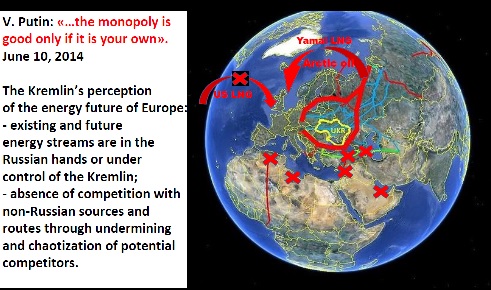
The Kremlin's perception of the energy future of Europe is reduced to two main visions: the control of existing and prospective ways of supplying gas to Europe, undermining the operation and chaotization of alternative suppliers of hydrocarbons (see chart):
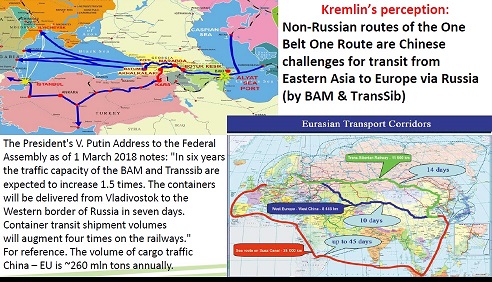
In continuation of such a concept, the Chinese initiative on infrastructure construction "One belt, one way" from the Russian point of view poses a threat to the functioning of Russian transport corridors, BAM and TransSib, used for the transit of goods from East Asia to Europe.
The separatist formations supported by Russia, in particular Abkhazia, plays an important role in drug trafficking from Russia to European countries through the Black Sea. Construction of the Kerch Bridge in the occupied Crimea will increase the drug traffic from Russia through the Crimean ports to Turkey, Bulgaria and Romania.
Also, in his report, expert focused on possible scenarios after the announcement by Gazprom of the termination of the contract for the supply of gas to Ukraine, the so-called gas blitzkrieg 2018. As a possible scenario, expert quotes a comment from one of the pro-Kremlin analysts: "Interruption of transit through Ukraine will take place before the start of a new heating season in automn 2018 ... The key idea of such blackmail will be to bring Europeans to the forced solution in the decision of the North Stream 2. In addition, the Kremlin will receive the tool of pressure on Turkey by the hands of Europeans, because Europe in its turn will put pressure on President Erdogan to accelerate the implementation of the second line of the Turkish Stream, which is also implemented not without complications, because the Turks reluctantly authorize the construction of a pipeline through their territory.
On March 13-14, 2018, President of the Center took part in the panel discussion "Energy Security: Markets, Politics, Technology" within the framework of the 11th Economic Forum Ukraine-Europe, which was held near the city of Rzeszow, Poland. In his speech, M. Gonchar emphasized the lack of consensus in the EU and NATO on hybrid energy threats inspired by Russia. "Disarmament" of the Russian energy policy should be carried out by means of the following measures:
- more oil imports to the EU from the non-Russian sources instead of Urals;
- more gas from the non-Russian sources via the non-Russian routes and more LNG deliveries from North America to the EU instead of the gas from Russia;
- integrated approach of the EU: NS2 is possible only under fulfilling conditions of the free transit of the Central Asian gas to the EU by Russia (through the territory of Ukraine and Slovakia);
- unprecedented in the history of the EU, actual test of the EU economy’s ability to operate under conditions of minimization of the imports of crude oil and petroleum products through engaging of the 90-120-days Strategic Oil Reserves.
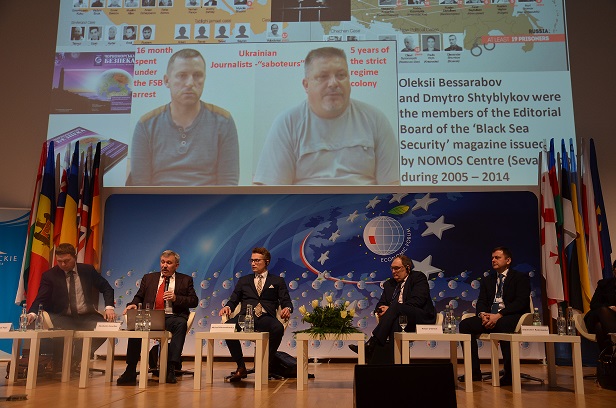
The final part of his report, M. Gonchar devoted to the problem of the political prisoners of the Kremlin in Crimea and Russia, in particular our former colleagues from the Sevastopol Center "Nomos", editors of the "Black Sea Security", Dmytro Shtyblykov and Olexii Besarabov.
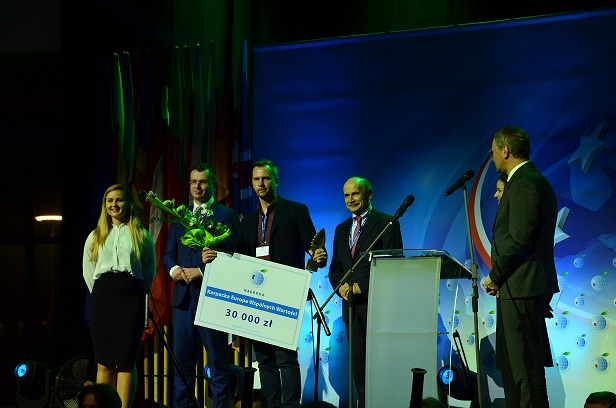
The forum also hosted the photo exhibition "Political Prisoners of the Kremlin". At a special event, relatives of political prisoners of the Kremlin drew attention of the world community to the lack of concrete steps in the issue of release of political prisoners, the number of which is growing steadily today. The number of political captives of the Kremlin in Crimea and Russia is currently 64 people - they are out of the so-called "Minsk process". During the awards ceremony of the Ukraine-Europe Forum, Oleg Sentsov was awarded the forum's awards with the world-famous director Jerzy Hoffman (on behalf of Sentsov, the award was given to the brother of Yevhen Panov, Igor Kotelyanets).
According to the results of international events, visited by the experts of the Center for Global Studies, we can say that the world community closely follows the security situation in the East of Ukraine and the Crimea, without neglecting the problem of increasing the Russian military presence in Ukraine and Russia's repressive policies towards Ukrainian citizens .


