


Among more than fifty participants of the event, there were heads and representatives of the foreign diplomatic missions to Ukraine, deputies of the Verkhovna Rada of Ukraine, representatives of the Government Office for Coordination of European and Euro-Atlantic Integration of Ukraine, the Ministry of Foreign Affairs of Ukraine, members of the UNP EaP CSF, Ukrainian scientists and experts. H.E. Ambassador Extraordinary and Plenipotentiary of Romania to Ukraine Cristian-Leon Țurcanu informed the participants on the Priorities and the Program of the Romanian Presidency of the EU Council.
In her welcome speech at the beginning of the event, General Director of the Government Office for Coordination of European and Euro-Atlantic Integration of Ukraine Olga Stefanishyna underlined the importance of the Black Sea region in the Program of the Romanian Presidency of the EU Council. “As a representative of the Government, I am very impressed by the focus that Romania has chosen for its Presidency - that is, the focus not only on the countries of the Eastern Partnership, but also on the entire Black Sea region. This means that we are ready to rally for common goals, regardless a status of belonging to the European Union. We must not also ignore the security challenges and issues," she said.
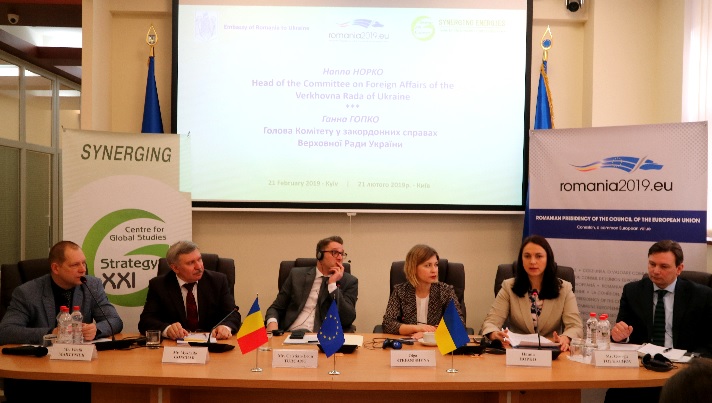
President of the Centre for Global Studies “Strategy XXI” Mykhailo Gonchar attracted attention to security and energy issues of the Program of the Romanian Presidency of the EU Council. “The Romanian side revived the problem of the Nord Stream 2, which was raised by Poland at one time. This is important for security issues, and not only in the context of energy security, but in a wider format,” he said. Mykhailo Gonchar noted the effectiveness of the first steps of the Romanian Presidency and proposed an asymmetric reaction on the violation by Russia of the Intermediate-Range Nuclear Forces Treaty (INF Treaty). The EU under the Romanian Presidency could initiate to suspend building of the North Stream 2 pipeline for six months - the term of the end of the duration of the Treaty, with the aim to force Russia to return to the negotiations.
While presenting the Priorities of the Romanian Presidency of the EU Council, H.E. Ambassador Extraordinary and Plenipotentiary of Romania to Ukraine Cristian-Leon Țurcanu informed that the Presidency of Romania is based on four pillars: 1) Europe of convergence; 2) A safer Europe; 3) Europe, as a stronger global actor; 4) Europe of common values. He expressed the full support of Romania to the territorial integrity and sovereignty of Ukraine, its European integration aspirations, as well as the desire of the Romanian Presidency to improve the security situation in the Black Sea region, because the countries of the region faced numerous new challenges. “We are convinced that the Black Sea security is not a security issue for only Ukraine or several countries of the region but for the whole EU,” Mr. Ambassador stressed and added, “Romania is not a neighbor of Ukraine, it is a friend of Ukraine”.
Head of the Committee on Foreign Affairs of the Verkhovna Rada of Ukraine Hanna Hopko called on the EU to develop a strategy for the Black Sea region and stressed that the Romanian Presidency in the EU is a good opportunity for Brussels to strengthen EU-US cooperation to counter common security threats in the region. "After the accession of Bulgaria and Romania to the EU, the Black Sea became the European Union's sea, but now we see how it is transformed into a "Russian lake" after occupation and annexation of the Ukrainian Crimea. The Kremlin has already placed the newest missiles in Crimea, brutally violating the Intermediate-Rage Nuclear Forces Treaty. Therefore, it is very important to have a strategic vision of Russia's deterrence in the Black Sea region and to curb Russian militarism," said Hanna Hopko. Also, she emphasized the need to stop the construction of the Nord Stream 2, the introduction of the Azov package of sanctions, the strengthening of the requirements for the release of Ukrainian prisoners of war, hostages and political prisoners illegally detained in the territory of the Russian Federation and the occupied territories of Crimea, Donetsk and Luhansk areas.
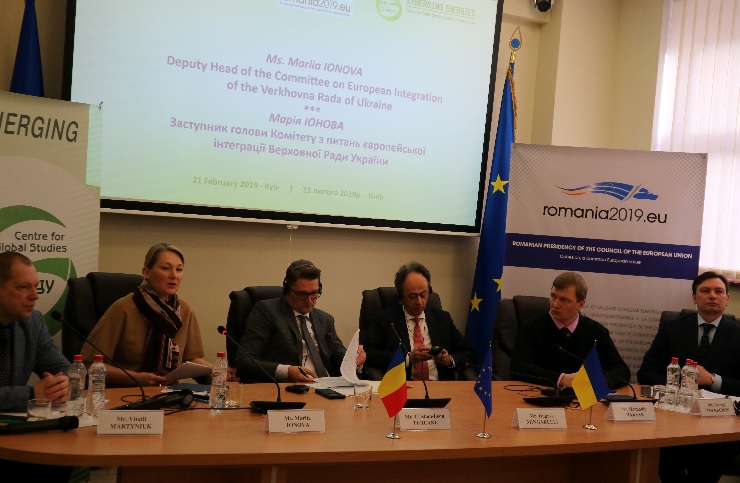
Deputy Head of the Committee on European Integration of the Verkhovna Rada of Ukraine Mariia Ionova informed about the priorities for Ukraine during the Romanian Presidency of the EU Council, and she also focused on the security challenges of the Black Sea region and the whole Europe, rapid militarization of the Crimea, aggressive actions of the Russian Federation in the waters of the Sea of Azov, and thanked Romania for attention to those issues. “We are thankful that on the Munich Security Conference President of Romania made clear expressions and announced an increase presence of NATO in the Black Sea region. This suggests that you are really aware of the threats that currently exist in the Black Sea,” she said. Mariia Ionova also stressed the importance of humanitarian initiatives of the EU in the Black Sea region, including concrete assistance to Ukraine, and applied to the Romanian Presidency to pay more attention to coordination of activities to protect the Black Sea, as well as basins of the Danube, Dnipro and Dniester rivers.
The Head of the EU Delegation to Ukraine Ambassador Hugues Mingarelli also talked on the importance for the EU of cooperation in the Black Sea region, mentioning the existing formats, in particular the Eastern Partnership, and the "20 Deliverables for 2020 for the Eastern Partnership". He recalled the clear EU position on the inadmissibility of Russia's aggressive actions in November 2018, demands for the immediate release of 24 Ukrainian sailors and three vessels, as well as the approval by the European Union of new sanctions for such actions by the Russian Federation and the decision to render assistance to the Ukrainian Azov region. “We have in mind to try to mobilize our cooperation programs and means of some international financial institutions, EIB and our member-states for improvement of the railroads and road connections between Mariupol and Zaporizhzhya and Mariupol and Odesa. We discuss details what we can do,” said Ambassador Mingarelli.
Continuing the security issues in the Black Sea region, Head of Division of the Directorate General for the EU and NATO of the Ministry of Foreign Affairs of Ukraine Georgii Tolkachov reminded the initiative of Minister Pavlo Klimkin to elaborate a comprehensive response from the international community to the fact of the Russian aggression in the Kerch Strait, which would include economic and security aspects. "Russia is trying to block the Azov Sea and make the population’s life unbearable in all respects. There is also a military threat of an invasion. Therefore, we expect that the strengthened NATO naval presence in the Black Sea will be deterrent," the MFA representative said.
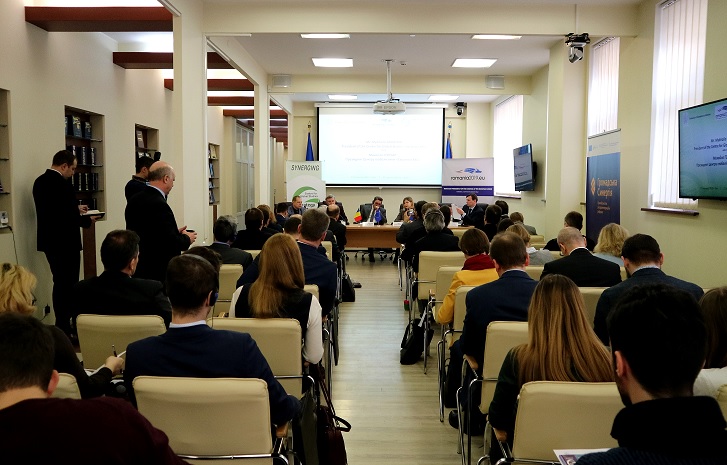
National Coordinator of the Ukrainian National Platform of the Eastern Partnership Civil Society Forum Hennadii Maksak outlined the expectations from the Romanian Presidency and the key areas, in which cooperation between Ukraine and Romania is possible. "The priorities that Romania has chosen for itself - Safe Europe, Stronger Global Player and Europe of Common Values, I would combine this way: "A stronger global player that combines security issues and values." This combination can change the approach of the European Union to those phenomena that are on the territory of the neighboring countries and those countries, which are totally ready to develop their European integration," he said. Hennadii Maksak also noted the importance of cooperation between Ukraine and the Romanian Presidency in the Black Sea region, the preservation of the pro-European movement of the countries that signed the Association Agreement, the creation of a full digital union, and the support of initiatives of the public sector.
In general, the participants of the event noted the need for a broad and multidimensional counteraction to aggression of the Russian Federation, especially in the Black Sea region, and called for enhanced regional security cooperation within the Eastern Partnership under the aegis of the EU.

--------------------------------------------------------------------------------------------------------------------------------------------------------
Views, expressed in the materials or announce at the event, are of personal positions of speakers and authors and not reflect views of the Embassy of Romania to Ukraine and the Centre for Global Studies “Strategy XXI”.


