


By Mykhailo Gonchar
Gas technologies is an important component of polyhybression[2].
Energy motives of Russian neo-imperialism
The statement by the Russian media in autumn 2015 was quite frank: "The overthrow of the Bashar al-Assad regime in Syria is threatening to change the balance on the European gas market, since in this case, Qatar can build a direct gas pipeline through the Syrian territory to Turkey ... Syria is one of the few conflict zones that holds back the formation of geographically correct and cheaper routes of delivering Qatar fuel to Europe."
A year later, one of the former Russian military leaders, head of the Main Directorate of International Cooperation of the Ministry of Defense of the Russian Federation, Colonel-General Leonid Ivashov, was even more frank: "If Russia had not entered there (in Syria - author) and had not supported the regime of Assad, then it would have been an existential threat to the Russian budget, since three gas pipelines are fighting there... The first route to establish was to Europe ... ".
The European energy market has reached the peak of consumption and is more and more saturated with energy from renewables that could mean a decrease in the share of Russian natural gas deliveries and, accordingly, a drop in Russia's revenues from its exports. The latter factor, although being not as determinative as export of oil and petroleum products, however, is considered to be a significant share in the total volume of revenues from Russian energy sales abroad.
Consequently, the military and energy policies of Russia are closely interconnected. And this connection is aimed at reformatting the geopolitical and geoeconomic space of Eurasia in accordance with the Kremlin worldview, in which Russia should occupy a dominant position, the EU and NATO cease to exist, while Europe becomes a high-tech attachment the resource based economy of Russia.
To achieve the goal, appropriate technologies have been developed, with the help of which it is planned to make the new conquest of the existing spaces of Europe.
Technologies of the reconquest of territories
The Moscow-Salisbury gas pipeline does not exist in the materialized form, but actually the respective communication channel exists, as the deadly gas has been brought from Russia to Britain and used there. The “incident” in Salisbury can be considered as an effort to adjust the technology of delivery of the weapon of mass distraction in the form of microdose for the pinpoint attacks on concrete targets.
The Nord Stream 2 gas pipeline still exists as a project estimate for two pipelines with a total capacity of 55 billion cubic meters per year. As the Nord Stream (exists since 2011) it should transport gas from Western Siberia and Yamal to Europe. This is also the technology and its core idea consists of not only in the transport of gas under the high pressure over long distances. Here is the case of multifunctional approach as described below.
Another technology is the work of Russian state oil and gas companies, as well as the Russian special services under their umbrella, against the European Union and NATO from inside Europe itself, but beyond the borders of the EU and NATO. A key embodiment of this technology is the Swiss Canton of Zug, where many affiliated with Gazprom companies are registered.
Three abovementioned technologies aimed at fragmentation of the Transatlantic and European integrity, where the global financial flows and high-tech technologies are generated. The goal to conquer Europe in addition to the rich Siberian and Yamal lands that it already owns, was set in Putin`s Russia a long time ago.
According to the Kremlin, perfect monopoly should look like the possession of natural resources and control over financial flows generated by them.
Destroyed and conquered by “firewater”
Long ago, the polar regions of Eurasia had their local rulers. Separate representatives of their degenerate descendants can now be found somewhere in Siberia and Polar regions. They were destroyed by "firewater", i.e., vodka. It was a primitive but effective technology. Circumpolar peoples are not adapted to alcohol consumption, so this beverage destroyed them. The occupants acquired vast territories with huge reserves of natural gas, a volatile odorless substance that is essential for industrial Europe.
Now Putin's Russia is conquering Western Europe, creatively adapting the technologies of the tsarist and Soviet Russia to the indigenous peoples of the North. Europeans are resistant to "firewater", although they like it. Romano Prodi once made a famous comparison of Russia and Europe with vodka and caviar. That quite eloquently testifies an inclination of the Europeans to be seduced by "firewater", but rather in the monetary equivalent for which vodka and caviar can be purchased. You can also use gas instead of money, because it can be purchased, and then vodka with caviar will be purchased.
“Money doesn’t stink” – this famous statement from the time of the Roman emperor Vespasian was taken into consideration by the Kremlin since the Soviet era, and in Putin's time corruption became a technology of the struggle against the West. The gas-money deal generates a deal "more gas - more money," "more money - more opportunities." Similarly as a "firewater" helped to conquer the territories that belonged to the indigenous people of Siberia and Arctic, these gas dollars help Russia to have high-powered positions in political and business dimensions in Europe, incinerating the European values in the souls of the modern Eloi (by H. G. Wells, The Time Machine) and gradually replacing them with the values of Mordor (by J. R. R. Tolkien). This is done in a rather elegant way, due to the technology of simultaneous export of hydrocarbons and corruption in Europe under the control of Russian intelligence services.
Crypto war against the EU and NATO
Cryptowar (Greek κρυπτός— secret, hidden) is the separate stage of unfriendly actions in an implicit form that are not perceived by the enemy as aggression. It is a form of hidden, systematic and prolonged exhaustion of the vital potentials of the enemy, which lasts until the time when a decision to start aggression of the classical or hybrid type is taken. The military potential is not used at this time. But the secret services are working to the full extent - they are providers of subversive activities from within the victim state.
The state-owned companies are of particular importance for success in cryptowar. Having a monopoly status or dominating the market, they operate energy infrastructure and, at the same time, supply energy to foreign markets. As, for example, Gazprom does. "The development of Gazprom, its transformation into a state-building empire-forming structure is Putin's great achievement, with which he, scattered pipes throughout Eurasia and connected them with Europe, Belarus, Ukraine and the republics of Сentral Asia. These territories, connected by the steel pipes, became a principium for the future great state. Gazprom is a civilized achievement of the Putin’s Russia…Gazprom…had saved the state, laid the grounds for the future Eurasian statehood. Gazprom is a steel flower bud, from which in future a flower of the fifth Russian empire will bloom,” – this is the perception of Gazprom by the pro-Putin intellectuals from the Izborsk Club. One can characterize this as a delirium of a separate category of imperialists. But we should turn to other sources.
Russia will augment efforts for main regional gas producing centers (countries of the Central Asia and Iran) and will seek to establish the Eurasian integrated gas transportation system for provision of export and transit cross-flows between Europe and Asia…Russian pipeline infrastructure will become an integral part of the “power bridge” between Europe and Asia, and Russia will become a key center of its management, " - this is what the Russian Energy Strategy until 2030 is aimed at.
The idea of Russia’s self-esteem, a scale and direction of its further actions are demonstrated in the keynote speech of Igor Sechin, CEO of Rosneft, the largest and most influential oil company in the Russian Federation at the V Eurasian Forum in Verona in October 2016: “There are objective conditions in Eurasia to reconstruct the continent's economic integrity. This can only be managed through the integration of traffic flows, flows of energy, energy resources, technologies and financial areas... Russia, thanks to its unique geographical location, is naturally intended to be a link, a kind of a "bridge" between Europe and Asia… Russian President Vladimir Putin set a task to build Eurasian Partnership on the basis of broad integration range...”
Consequently, the perverted representatives of the Izborsk Club, the official documents, and a silogarkh[3] Sechin are in one direction - neo-imperialism through the reengineering of the geopolitical and geoeconomic space of Eurasia. Cryptowar is the way to achieve the goal.
In practice, the proposed and attractive model of the energy bridge is concealing the energy penetrator model - a mechanism for gradual penetration and imposing dependence on Russia through energy supplies to the leading European countries, their geopolitical reorientation from the Euro-Atlantic to the Eurasian model, the spread and consolidation of the dominant Russian influence on Europe. In this context, Putin's statement that the borders of Russia don`t end anywhere does not look like a joke.
The EU does not identify Russian energy bridge as a threat. On the contrary, it is an attractive business model for the western mentality. This is the nature of hybrid threats - they do not look like threats, on the contrary, they are attractive. Russian gas flows through the Baltic and the Black Sea are a practical embodiment of the model of energy bridge. The mythical sirens, who seduced Odysseus with sweet singing and directed seamen to be shipwrecked on the hidden underwater rocks, can be considered as an artistic image of the Russian energy bridge. For a successful "сrusade to the West," it is important to choose an appropriate bridgehead.
Swiss bridgehead for Russia
Few experts even draw attention to the fact that Switzerland has become a favorite location for the headquarters of Gazprom’s commercial and development companies, when it came under the control of the "Petersburg Chekists" team. The incomplete list of Gazprom’s affiliated companies, which were created in different times during the Putin period on the territory of the Alpine "workshop of money and chocolate" looks like this:
- Gazprom Schweiz AG, registered on May 14, 2003, Pelikanplatz 15, 8001 Zurich;
- Rosukrenergo AG, registered on July 22, 2004, Bahnhofstrasse 7, 6300 Zug;
- Nord Stream AG, registered on December 2, 2005, Grafenauweg 2, 2304 Zug;
- South Stream AG, 18 January 2008, Industriestrasse 13C, 6304 Zug;
- Shtokman Development AG, 21 February 2008, Baarerstrasse 8, 6301 Zug;
- Gazprom Marketing&Trading Switzerland AG, 7 December 2011, Industriestrasse 13C, 6304 Zug;
- Nord Stream 2 AG, 14 July 2015, Baarerstrasse 52, 6300 Zug.
The peculiarities of the Swiss business were described in my article "The Victory of Gasocracy over Democracy, or on Russian Flows of the European Gas Corruption" (see DT.UA No. 27 of August 8, 2014, original article "Перемога газократії над демократією або про російські потоки європейської газової корупції).
Let us remind readers briefly. The registration of a company in Switzerland means that its activity is not under the control of any competent authorities of the EU and its member states. The most important feature of companies like RosUkrEnergo (RUE) is the presence of two types of shares- registered and bearer. The bottom line is that according to the decision of shareholders (Gazprom always holds a controlling stake there), registered shares can be transformed into bearer shares (anonymous), and vice versa.
The bearer share certificate does not contain any information about the owner. The holder of such certificate is automatically considered the owner and it is not registered in the company's register. Neither a company nor a shareholder meeting, nor any responsible person is obliged to ascertain the way its owner received it. The bearer shares are transferred through the physical delivery of the certificate.
Selling such shares does not require an input of any related information on the certificate or the drawing up of an accompanying document. Anyone who owns such shares may deny personal involvement, as his name does not appear there, but to demand and receive dividends on a regular basis. This opens a wide range of opportunities for corrupt actions.
According to the decision of the management board at such type of business entity, money can be transferred to certain accounts, which belongs to different individuals or legal entities.
This scheme is a perfect tool for pan-European corruption, when a part of the financial flow, generated by the sale of hydrocarbons, is directed through the mechanism of the "black box" to accounts of lobbyists, politicians, officials, journalists, various think tanks, political and extra-parliamentary forces in different EU member states. In fact, this is a Russian cryptowar scheme, which was successfully tested in Ukraine (RUE scheme) and now is being successfully implemented in Europe, however remaining unnoticed.
The Swiss scheme of Gazprom business is a product of creative cooperation of two people who served at one time in the special services of the former GDR and the former USSR. They are Matthias Warnig, the officer of one of the best intelligence agencies in the world during the Cold War - the East German HVA, better known as the Stasi, and Vladimir Putin, officer of the Soviet PGU KGB, who served in the GDR.
Stasi had a widespread network of communications in Western Europe, primarily in Austria and the German-speaking cantons of Switzerland (Zurich and Zug). It is no coincidence that M. Warnig got a code name "Economist" – he had been trained in the Stasi precisely for penetration into the western banking system. He successfully coped with that, but at the different historical stage.
After the unification of Germany, the dissolution of the USSR and V.Putin`s rise to power in post-Yeltsin Russia, the cooperation between two friends received new opportunities and scales. M. Warnig played a key role in the transition of the "Petersburg Chekists" team to the elegant schemes of Gazprom activity through business entities created in Austria and Switzerland, using the peculiarities of the economic law of these countries. Schemes named after S. Mogilevich (Eural TransGas) differ from the Swiss schemes of Gazprom, named after M. Warnig, as well as the East German Trabant differs from the modern Mercedes.
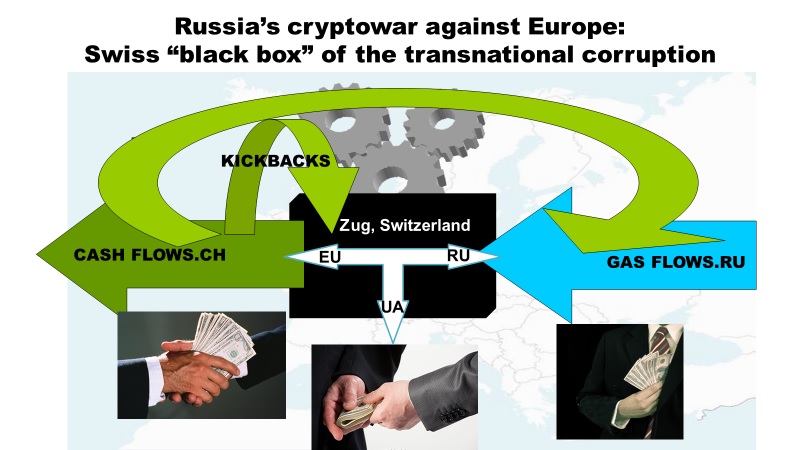
Gazprom's affiliated companies in Switzerland are not just commercial and development firms. They are a “protective umbrella” (krysha) for agents of the Russian secret services in Europe to implement the strategic task: create the system of external influence and management in the governments of the leading European countries. At the same time, the proxy operator is the union of powerful European energy companies with the dominant role of Gazprom. Relevant influences on governments and EU institutions are possible due to their activities.
If we consider that Gazprom is a continuation of the Kremlin management structure, then the whole chain of influences also becomes evident. So, although the Moscow-Zug-Berlin route does not transport gas, it provides a certain financial flow and retransmission of influences from the Kremlin. The financial capacity of the opaque gas business scheme and the expanded network of lobbying and corrupt communications allow Russia to actively influence the branches of power in a particular country by manipulating it .
The phenomenon of transnational "gas octopus" is no less unique than the phenomenon of drug mafia. The consequences of "gas octopus" existence are not less extensive than of its narcotic counterpart.
Technology of "geopolitical corruption"
On May 23, 2002, the National Security and Defense Council of Ukraine adopted the decision on Ukraine's membership in NATO. This caused a shock in Moscow. Russia resorted to covert acts to discredit Ukraine and the then president Leonid Kuchma through "Kolchuga Gate" and the Gongadze case. Consequences were a soft isolation of Ukraine and distancing of the Alliance leaders from the Ukrainian leadership.
Moscow declared a disagreement with the isolation of Ukraine by West and offered a “helping hand”, that meant an active participation in integration processes in the post-Soviet space under the auspices of the Russian Federation. In December 2002, a "financial incentive" appeared - an opaque gas trading scheme through a hastily created and registered in Hungarian village intermediary - the Eural TransGas, led by alliance of Gazprom, the Russian special services and organized crime (Gazprom + the FSB + S. Mogilevich).This scheme caused a crushing criticism of Ukraine's leadership, both internal and on the part of major foreign partners, especially the United States. With this scheme Russia additionally discredited Ukraine, suspending its Euro-Atlantic integration, but failing to completely stop the movement towards the West.
Therefore, further corruption technology was improved at the start. At the end of July 2004, the Swiss "transparent scheme" of RosUkrEnergo appeared. Later, it turned out that a couple of weeks before this, in the "Military Doctrine" of Ukraine, which was approved in June by the decree of President L. Kuchma, another decree with a correction was signed, where an article on membership in NATO as the ultimate goal for Ukraine`s Euro-Atlantic integration was excluded from the text. The RUE scheme actually became a bribe to the political leadership of Ukraine for refusing to join the Alliance.
However, after the Orange Revolution, Ukraine's course to join NATO was restored. President Viktor Yushchenko's by his decree in April 2005 renewed the status quo ante. Unlike the EU, in NATO post-revolutionary Ukraine was considered as a potential candidate for membership. The task of neutralizing the Euro-Atlantic movement in Ukraine became more complicated for the Kremlin. Corruption of the Ukrainian leadership only, through the RUE scheme, was clearly not enough, and it was necessary to act in western direction. And this was done through the project of the North European Natural Gas Pipeline. In 2005, Gazprom radically transformed this project: gas from the Shtokman field in the Barents Sea should have arrived to Europe by the Nord Stream (55 billion cubic meters per year), targeting to deliver Siberian gas to Germany bypassing the traditional route of supply through Ukraine and Slovakia.
A key partner was Germany and its companies. Mattias Warnig had proposed a Swiss scheme in order to create an "independent company" for the implementation of the project and was appointed as its managing director. Former German Chancellor Gerhard Schroeder, who was an active supporter of the North European Gas Pipeline, after electoral defeat of his party in parliamentary elections in December 2005, was appointed by Putin as a chairman of the shareholders’ committee of the newly-established "independent company." In such a manner Schroeder and Warnig headed a Nord Stream AG project registered in the Swiss Canton of Zug.
Only German Minister for Economics and Technology Michael Glos expressed his displeasure over the fact of registering the project in Switzerland that meant withdrawal from the tax field of Germany. There were many doubts about the fact that the project was controlled by former Soviet and East German secret services. To demonstrate the importance of the Nord Stream for Europe, Russia provokes a gas crisis at the beginning of the year 2006, which sought to make Ukraine an unreliable transit partner. After an artificially created gas crisis, it became much easier for Schroeder and Warnig to find the supporters of the Nord Stream in the EU and to reduce the number those who supported Nabucco gas pipeline. The last one was approved in the EU as a priority; it had capacity of 31 billion cubic meters of Caspian gas, which should have come to Europe as an alternative to Russian gas in 2019.
In 2008, Russia initiated the South Stream project (with capacity of 63 billion cubic meters annually) and forced the implementation of the Nord Stream, considering Germany, France, Austria, Italy and the Netherlands not only as the major partners, but also as a group of countries with a decisive influence on the EU decision making, while four of them had a significant impact on the NATO's decisions.
At the April 2008 NATO Summit in Bucharest, Ukraine received a Franco-German veto on joining the Alliance’s Membership Action Plan. The Nabucco project was gradually losing its support, and its initiator, the Austrian company OMV, became increasingly enthusiastic about Russian gas pipeline initiatives. In summer 2013, OMV officially announced the project to be cancelled.
The South Stream fulfilled its mission as a killer for Nabucco and was abolished by Gazprom in December 2014, when it was convinced that its mini version of Nabucco West was dead too. It was then regarded as a victory of the European Commission over Russia in its attempt to circumvent the EU's Third Energy Package. The history of the South Stream, undoubtedly, was a defeat of Russia and Gazprom. However, in Moscow, it was transformed into a future-hoped victory. Instead of South Stream, Russia in the short run initiated two new projects, Nord Stream 2 and the TurkStream, with a total capacity of 86 billion cubic meters per year. It is noteworthy that the initiation and promotion of the second line of the Nord Stream in the Baltic Sea took place when the blitzkrieg of Russian aggression against Ukraine failed. That forced Moscow to act according to scenario B, in other words to accept the "peaceful" Minsk process, negotiations in the "Normandy format" with the key role of Germany and France.
It was important for Russia not to be recognized as a party to the conflict, an aggressor, but Ukraine did not receive the weapon from NATO countries. In the end, that happened. France and Germany identified Russia as an intermediary in the settlement of the "Ukrainian crisis", the German initiative against Ukraine was in fact an arms embargo. A group of leading companies from the Normandy format member countries (two German and one French) together with Austrian and British-Dutch counterparts formed a partnership to implement the Nord Stream 2, which received support at the official governmental level in Berlin and Paris.
Consequently, the Warnig-Putin technology to conquer Europe through the Swiss bridgehead worked quite successfully. A precise conclusion was made at the time by the German MEP Bernd Posselt, who described the appointment of G. Schroeder to Nord Stream AG as a "payment for silence" of Germany, at the period when Schroeder was the Chancellor, over the war in Chechnya and the limitation of democracy and freedom in Russia.
Something like this can be said about the current German leadership, which although (but not yet) has not gone on the path of its predecessor, but does not call things by its right names: Russia's war against Ukraine is not called an aggression, but so-called conflict in Ukraine; Russia is not called an aggressor, but a mediator in the settlement of the "Ukrainian crisis". Germany does not see the mass violations of human rights by the Putin regime both in the occupied territories of Ukraine, especially in Crimea and Sevastopol, and in the RF itself.
Interestingly, one of the reasons for the Nabucco gradual loss of priority in the EU was a brutal violation of human rights and repression against civil society in the country from which it was to receive natural gas – in Turkmenistan. Thus, Russia`s gas-dollar diplomacy from the Swiss bridgehead bear fruit in Berlin, Brussels, Paris and in many other capitals.
Not least this explains why the Netherlands, whose companies have been actively involved in the Russian oil and gas projects for so long, cannot figure out who exactly had downed the MH17 flight in July 2014, where 193 Dutch citizens died. You can be sure that when in the end, after a few year investigation, the results will appear, a "group of people" will be recognized responsible for that, but not Russia as a state and not V. Putin as its head, who authorized the military crimes.
Putin’s cartoons: distraction of attention
Well-known Putin’s cartoons, demonstrated by him during the appeal to the Federal Assembly, were considered in the expert community as bravado, bluff and manipulation. This was the case, but it also was the distraction of attention from those processes that are conducted in Russia and remain unspoken. In fact, the unconventional use of weapons of mass destruction - chemical, biological and nuclear, is meant in Russia. A specific feature is that it is not about the megatons of a TNT and millions of victims as during the Cold War, but about blurring the lines in use of weapons of mass destruction; between its invisible at the initial stage use in small doses and the sudden appearance in the enemy’s rear in order to create a strategic advantage. The enemy will not simply be able to determine the source, mode of application and will not be able to react appropriately. The incident in Salisbury confirms this suggestion.
When it comes to unconventional use of the WMD, it means that it can be used or prepared for use not in the traditional way – with ballistic, cruise missiles or aircrafts, but it can be delivered with the assistance of civilian infrastructure. However, the radar can scan the area by watching Russian strategic aviation aircrafts, but in fact weapons of mass destruction can be delivered in a completely unexpected way.
For example, everyone is well aware that Nord Stream gas pipeline maintenance is scheduled on an annual basis. In case of necessity it can be done on an unscheduled basis. Special cleaning and intelligent tools (pipeline pigging) are used to provide the diagnostics of the pipeline from Russian to German coast. It`s not difficult to install a microcontainer with bacteriological or virus content, which would be opened by the software command on the German coast, while removing it from a special camera after the route service was completed. Then, an unknown disease can cause the epidemic in the territory of the country, which through propaganda media resources can be displayed as infection spread by the refugees from Africa. This will lead to a further surge in xenophobia, the growth of the popularity of radical political forces and political destabilization. The Russian sources often refer to the nonlinear approach to the use of biological weapons in Europe. They say, in the eighteenth century the European colonizers passed Indians the blankets and other things that were previously used by patients with smallpox. That caused an outbreak of a deadly epidemic that destroyed the tribes. That was the way how colonizers freed the living space.
Relevant research on the use of civil infrastructure and compactification of the WMD was launched in Russia yet in the Soviet times. As can be seen from the example of the Salisbury incident, the chemical compactification was successful. But relevant processes were conducted not only on the chemical or biological WMD. The same applies to nuclear weapons. Indirectly, former Deputy Prime Minister of the Russian Federation, Dmitry Rogozin, hinted at availability of the certain nuclear-armed secrets of Russia on September 22, 2014: “Should we amaze our colleagues, and is it necessary to brandish all types of weaponry to surprise them? Something must be preserved as a quiet secret for yourself to reveal at the most critical moment”.
Consequently, the dispatch center for managing Russian streams is not located in Russia or Germany, as many people may think. It is also located in Switzerland. And this is not a coincidence. Working from Switzerland with the use of European telecommunication networks provides unique opportunities for cyber-attacks. Modern cyber capabilities and unlimited financial resources of Gazprom's proxy operators in Switzerland widen horizons for hybrid wars. This is a proven Russian practice of creating proxy entities ranging from RUE (an "independent Swiss operator" to a transnational scheme for geopolitical corruption) to the "independent" “DNR/LNR” for the geopolitical entrenchment of Ukraine in the Eurasian zone.
The described technologies of Russian activity in order to reconquer Europe are technologies of polyhybression or multifrontal multidimensional hybrid aggression. Gas technology is an important component of this aggression. This is something that cannot be understood by the rationalistic European mentality where business and politics exist independently, energy resources are the sources of energy and cannot be a weapon, and corruption exists only in the underdeveloped and authoritarian states. The biggest news of May 2018 was a fact of concluding by the European Commission a long-running antitrust investigation against Gazprom monopoly on the markets of Central and Eastern Europe. Even though the abuse was proved, and multi-billion dollar fines threatened Russian monopolist. In the context of the facts described in this article, it becomes obvious that the fines, which Gazprom managed to avoid, would turn to the respective honoraria to those who helped for the last four years.
Russia's multi-route gas export system is aimed not only at diversifying the volumes, directions and prices of export supplies to the EU market in order to maximize revenues. At a certain time, this could be a mechanism to put pressure on a certain EU member state and NATO by threatening to limit / interrupt supplies. American expert Mikhail Korchemkin from the East European Gas Analyses (USA) came to the similar conclusions yet in 2009 and he stated that Russian flows are not designed to increase the supply of Russian gas and definitely not to increase the reliability in energy supply in Europe. Its purpose is to increase Gazprom's ability to cut off gas to some countries without detriment to others. This is precisely what Russia needs - divide and conquer via strengthening the dependence on Russian energy resources and cash flows from the Alpine cantons of Switzerland under the control of the RF special services.
In the EU Global Strategy, adopted in 2016, there is no lack of proper assessment of the threats to the EU, especially hybrid ones. However, in practice, the EU is not able to identify them, and even more, to counter them. It seems that in cryptowar of Russia against Europe the latter is doomed. Only the "stick" of the American "cowboy" can both stop the Nord Stream 2 and put an end to such Russian policy against Europe. Unlike the weak Ukraine, which has already been countering Russian hybrid aggression for five years, a strong and big EU demonstrates its feet of clay more and more.
[1] First publication of article was in the leading Ukrainian Mirror Weekly: “Газові технології Кремля: "Північний потік-2", "Москва—Солсбері", "Цуг—Берлін", May 18, 2018. Source: https://dt.ua/energy_market/gazovi-tehnologiyi-kremlya-pivnichniy-potik-2-moskva-solsberi-cug-berlin-278198_.html
[2]Translator’s note: polyhybression – multidimensional and multifrontal hybrid aggression of the Russian Federation that became evident after occupation of Crimea and war waged by the Russian-led proxies in Donbas. The term “polyhybression” was introduced for the first time in the book “Wars-XXI: Russia’s Polyhybression”, 2017 by Mykhailo Gonchar.
[3]Translator’s note: The American professor Marshall Goldman, author of the book Petrostate: Putin, Power, and the New Russia (2008), introduced the term "silogarkh" (from the "silovik"), referring to the economic model of Putinism, where energy resources are controlled by natives of the Soviet and Russian special services.


