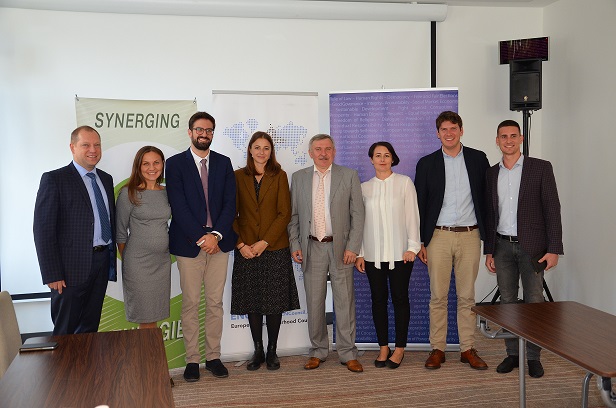
The panelists stressed the importance of coordinated cooperation between Ukraine and the EU and NATO. Serhii Saienko, Acting Director-General of the EU and NATO Directorate General of the Ministry of Foreign Affairs of Ukraine, stressed that the joint counteraction to hybrid threats should be in the center of such cooperation. Therefore, it is necessary to develop effective multilateral platforms involving government bodies, think tanks, scientific institutions and non-governmental organizations.
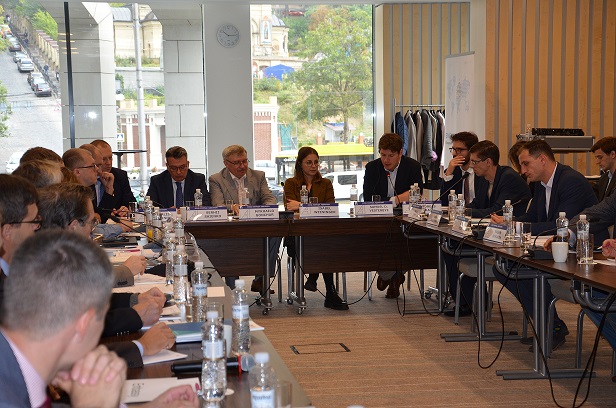
The participants of the discussion defined the following threats to information security: creation or restoration of the “societies of friendship” by Russia in the countries of Europe and the world; the use of national television and other media channels by Russian propagandists for the dissemination of disinformation; creation of a distorted alternative reality, especially in Ukraine, by Russian information resources to destroy the foundations of statehood; misinterpretation of some information in Wikipedia, which is perceived by many as a reliable source of information; the use of messengers like Viber and WhatsApp as channels of dissemination of disinformation; dissemination of fake news about Ukraine, which affects the interests of Western countries; creation of the so-called "representations of “L/DPR" with the status of non-governmental organizations in Europe; lack of clear messages from the Ukrainian authorities that gives opportunities for manipulations; creation of centers of disinformation in Europe, which disseminate it in national languages (for example, “Sputnik”). According to Veronika Špalkova, Member of the Kremlin Watch Program, there are 40 websites in the Czech language for dissemination of disinformation in the Czech Republic.
During the discussion, the following cyber threats and challenges were defined: vulnerability of the critical infrastructure; use of unlicensed software, especially in public institutions; registration of Russian information Internet channels, including those of the so-called “DPR” and “LPR”, on servers in Ukraine and European countries; the use of the world payment systems, in particular – PayPal, by the so-called "DPR" and "LPR"; the use of mailboxes of public authorities for hacking. In addition, Dmytro Dubov, Head of Department of information security of the NISS, and Volodymyr Kyrychok, Representative of the Cyber Police Department of the National Police of Ukraine, drew attention to the imperfection of national legislation in the field of cyber threats and cybercrime that significantly reduces the effectiveness of the state law enforcement agencies.
While discussing ways to counter information and cyber threats, Samuel Doveri Vesterbye, Managing Director of the European Neighborhood Council, noted that national authorities should play a leading role in this process. At the same time, Ukraine's cooperation with the EU and NATO as organizations and their member states as well as the Eastern Partnership countries is becoming increasingly important as Russia invents nothing new and uses predominantly template methods against different countries, adapting them to national circumstances.
The panelists, in particular - Ruslan Deynychenko (StopFake), Veronika Špalkova (Kremlin Watch) and Alya Shandra (Euromaidan Press), suggested the following ways to counteract information threats: to create more information resources to expose disinformation and propaganda; to create truthful information content to be more interesting for the audience than fake messages; to increase media literacy; to deny licenses of media resources whose activities are harmful to national interests; to apply sanctions against media resources, which disseminate disinformation (for example - to suspend a license for a limited time); to find channels of covering Russian audiences to spread truthful information.
In order to counter cyber threats, the following measures were proposed: improvement of the legislation on counteraction to cyber threats and cybercrime (in particular - increased punishment for cybercrime); increasing of cyber hygiene and literacy; the use of licensed software only; transition of all state-owned web-sites into the domain “gov.ua”; development of mechanisms of penalties for companies, which provide possibilities to so-called “DPR” and “LPR” to register their information resources in violation of the US and EU sanctions. In this context, as Kiril Milev, Senior Adviser on Cybercrime of the EUAM, said, Ukraine needs to fully adapt its legal framework to the EU rules and requirements of the Budapest Convention, and apply the EU best practices.
In general, as Kakha Gogolashvili, Director of the European Studies at the Georgian Foundation for Strategic and International Studies, stated, counteracting hybrid threats, especially in the information and cyber spheres, should become an integral part of the European integration processes of the Eastern Partnership countries. At the same time, Mykhailo Gonchar, President of the Center for Global Studies “Strategy XXI”, stressed that in order to further develop European and Euro-Atlantic integration processes, it is necessary to deepen clear communication both inside Ukraine and outside - with the EU, NATO and partner countries.
The record of the full discussion is available here (in Ukrainian) - https://drive.google.com/file/d/1UOKOFYa3QHvsOKqrGB4vmUZUhAlsM6xg/view?usp=sharing