


Some structural changes, in addition to corruption scandals and attempts to redirect financial flows for "right" people and companies, that DT.UA described in detail, have occurred in oil and gas production sectors, on the market of petroleum products, as well in the gas sector. It is still difficult to name this the beginning of systematic structural market reforms. Because, any significant effects may be seen at best in 2017. However, there were also many notable events and they were different. Possible impact of main events and the trends that have emerged will be discussed in this article.
Oil and gas production is profitable but risky business
The main result of the year for extraction industry can be seen in stabilization of gas production. Almost 20 billion cubic meters of gas were produced, or 100 million cubic meters more than in 2015.
But the year 2016 did not bring expected improvement of the situation on the market for oil and gas production companies. There were, however, some hopes at the beginning of the year, as from the 1st January of 2016 the rate of rent on gas extraction was significantly reduced for private companies: from 55 to 29% at the depth of the wells to 5000 m and from 28 to 14% for wells deeper than 5000 m. In fact, the producers returned to fiscal conditions which existed before August 2014.
The next important step was the increase from April 2016 of procurement of gas prices for the state company UkrGasVydobuvannya (the UGV) from 1590 to 4849 UAH per thousand cubic meters. At the same time, the rent for state-owned company was reduced from 70% to 50%. This step gave the opportunity for the first time in the history of the company to shift gas production into a profitable business. The UGV got huge financial resources, company's revenue in 2016 has tripled compared to 2015 — to 64 billion UAH.
However, tangible results were not marked in 2016 because of reduced rents and increased companies' revenues. Total Ukrainian gas production increased by a modest 0.5 percent, or 100 million cubic meters. The production of oil and condensate declined significantly by 8% or 200 thousand tons.
UkrGasVydobuvannya: undeclared fracking results and shady "drillers"
High hopes for the growth of gas production were primarily associated with the state company - PJSC "UkrGasVydobuvannya". This summer the UGV tried to improve the situation through realization of large investment projects - purchase of modern equipment for repair of wells (coiled tubing equipment), and of rig fleet to conduct hydraulic fracturing. In addition, the UGV launched the program 20/20, which envisages increase in production to 20 billion cubic meters by 2020.
The company held a tender for outsourcing for hydraulic fracturing in the amount of UAH 370 million. The tender was won by "Belorusneft" and Romanian "Tacrom Services", each of which received an order for 50 fracturing operations. Until December the units of the PJSC "UkrGasVydobuvannya" carried out hydraulic fracturing at ten wells, and "Belorusneft" carried out same operations at about ten wells. Tacrom Services didn't conduct any hydraulic fracturing by December. The UGV didn't comment the results of conducted hydraulic fracturing.
Large hopes were put on attraction of drilling companies, due to which it was planned to rapidly increase drilling activity and, as a consequence, extraction results. The bidding process was announced only in late October, and the UkrGasVydobuvannya has submitted RFPs on 15 rigs for 90 wells with a total value of 13 billion UAH (about 500 million dollars). Such amount is significant even on an international scale. However, contrary to expectations, American and Canadian drilling companies, which are rightly considered world leaders in this segment and were very interested in the UGV tender, didn't put their bids. Only one Ukrainian drilling company participated in the tender, the others didn't reach understanding with the UGV in the process of tender preparation.
But it was surprise and disappointment when as a result of the tender the lowest price for all lots was offered by not known company "PivnichGasRessoors" ("NorthGasResource"). Next lowest price was proposed by "Victorious company." Both companies are registered at the same address. The third company with low price offer was "british" Drilling Energy Technics Limited, which, as it turned out, had the site only in Russian language, and it was quickly closed "for reconstruction". Now the UGV needs a lot of time and efforts to abandon such "drillers".
In late December, the UGV announced another tender for purchase of five heavy rigs for 3.55 billion UAH. The winners will be only announced in the spring of 2017.
As for the year results, then in 2016 the UGV produced 14.6 billion cubic meters of gas, that is by 70 million cubic meters (0.5%) more than in 2015. While production of oil and condensate decreased by almost 60 thousand tons (about 11%). In 2017, the management of the company plans to increase gas production by 500 million cubic meters.
"Ukrnafta". Stabilization one pace away from bankruptcy?
Last year was even more challenging for "Ukrnafta". Huge debts of about 12 billion UAH to the State Fiscal Service (SFS) of Ukraine, high tax burden, 45% of rent on oil, and low oil prices led the company to the brink of bankruptcy. At the same time, it should be noted that since May the level of oil and gas production was stabilized. This was achieved through simple and inexpensive methods, such as deployment of new efficient electric centrifugal pumps. However, this is temporary stabilization, as it’s said in the company. Without increasing investments, particularly in drilling, it is expected further decline of production by 10-15% next year.
If we talk about private companies, then in 2016 in Ukraine almost 50 companies were involved in gas production, which produced slightly more than 4 billion cubic meters of gas or 20% of its total production in Ukraine. At the end of the year production growth was only 7%, while the last four months the indicators are negative.
There are several negative factors that influenced deterioration in operating performance. The main factor is the low gas price, which didn't exceed 6000 UAH (including VAT) per thousand cubic meters in the summer. And only in October the gas price started to go up and in November-December exceeded 8000 UAH (including VAT). The low price of gas during the year didn't contribute to increase in investments in exploration and production of hydrocarbons.
Another problem for private companies was pressure from law-enforcement agencies (so-called "siloviki" - Prosecutor General's Office of Ukraine, Security Service of Ukraine - SSU, the SFS), as well as from political opponents or local government authorities. Almost all major extracting companies, which in some way are connected to big businesses, have become a target for "siloviki" over the past year: PrJSC "Naftogazvydobuvannya" (part of DTEK), Burisma, "Smart-Holding", "Poltava Oil-Gas Company" (subsidiary of the British JKX).
The next challenge for extracting companies was the lack of new license areas. In 2016, the State Service of Geology and Mineral Resources of Ukraine held two auctions for sale of special permits. At the first auction in March five special permits were sold: South-Kisivska and Murafinska sites in Kharkiv region, as well as Bistricka, Pidgirtsivska and Dobrovlyanska sites in Lviv region. The auction ended with scandal: the company "Yuteksnaftogas", which was expelled from the auction, sued the State Service in the court. At the second auction in December, only one license was sold - for Tereblyanska site in the Transcarpathian region.
Low number and low quality of special permits for proposed oil and gas sites restrict significantly growth of gas production in Ukraine.
The biggest disappointment for private gas producers was the failure of voting for introduction of an incentive rent at 12% for gas from new wells. This rule was planned to be introduced since 2017, instead of the rent 29% for extraction from wells up to 5,000 m and 14% for wells deeper than 5000 m. This innovation should have to encourage extracting companies to drill more and to invest in production. The corresponding Law draft No. 5459 was proposed to the Verkhovna Rada and considered there in late November. The deputies supported it in the first reading. But in the process of preparing the State Budget for 2017, the representatives of the Committee on Taxation and Customs Policy decided to remove this rule.
Prospects for development of private extraction are very limited. The chances to attract foreign investments in the Ukrainian oil and gas sectors are close to zero, and Ukrainian companies do not have enough own funds for such development.
The largest private extracting companies remain PrJSC "Naftogazvydobuvannya" (part of DTEK) with 1.6 billion cubic meters of annual production and BurismaGroup with about 1.1 billion cubic meters. The fastest growing company in 2016 was "Ukrnaftoburinnya", which increased production by 30% to 0.3 billion cubic meters and took the third place by volume among private companies.
The time of turbulence
The down-stream oil sector, which includes transportation, refining and sales of crude oil and petroleum products, was full with various events in the past year. The year 2017 promises to be not less interesting; during 2017 various scenarios of activities of the major segments of this industry are possible.
Transportation: waiting for "sea" oil
The outgoing year 2016 for the state-owned company "Ukrtransnafta" became the first full year that went without "Privat's" management. Let me remind, Igor Kolomoisky's creatures were fired in the spring of 2015 after six years of managing the oil transportation company. This immediately affected the financial results of "Ukrtransnafta" and its transparency. In particular, a group of international auditors started periodic financial audit of the company for the first time in its history.
Having removed subjective factors from the agenda, "Ukrtransnafta" was left alone with objective factors, in particular with the changing oil market situation, which is still playing against the company. However, there are some reasons to believe that the situation may soon give new impetus to Ukraine's oil pipeline system. In 2016 the volumes of oil transportation fell by 9.1%, or more than 1.5 million tonnes.
Table 1. Oil transportation by Ukrtransnafta in 2015-2017, thousand tons
| 2015, final | 2016, forecast | 2017, planned | |
| Total, Ukrtransnafta | 16 760,3 | 15 233,9 | 16 700 |
| Transit | 15 153,5 | 13 822,2 | 14 000 |
| Other refineries | 1 606,8 | 1 411,7 | 2 700 |
The main negative factor was diversification of oil supply by MOL, which decided to replace part of Russian oil for its Hungarian refinery with Caspian oil that devivered from the South through the Adriatic. The second largest recipient of oil through "Druzhba" oil pipeline system - Unipetrol - reduced purchases of Russian oil partly due to technical problems at the refinery in Litvinov (Czech Republic).
The decrease in oil transportation to the only refinery "Ukrtatnafta", which operates in Ukraine, fully reflects the decline of oil production of the main supplier of this refinery - the company "Ukrnafta" - by more than 10%.
The coming year may go through completely different scenarios. First negative scenario is the intention of Unipetrol, that is part of the Polish PKN Orlen, to reduce purchases of Russian oil via "Druzhba" by 1 mln tons. It is explained by the requirements of the European Union to diversify sources of oil supplies. This did not though prevent the Polish group from signing last year a three-year contract with Rosneft, which would provide almost 100% of oil for refinery in Płock. So, there are still some options.
It is unlikely that "Ukrnafta" will be able to stop the decline of oil production, such expectations are more justified for 2017-2018. But while working out the plans, "Ukrtransnafta" sincerely believes in sustaining oil production level by "Ukrnafta".
The positive scenario is mostly associated with a project of "sea" oil supply, in particular from Odessa to Kremenchug. It is stated that from 2017 "Ukrtatnafta" would start supplying 1.3 million tons of light oil by the sea. A Memorandum has already been signed with "Ukrtransnafta", which will be ready from January to implement this project.
Other positive surprises are not excluded. In the second half of 2016, Moscow has put Belarusian refineries on an oil diet, cutting oil supplies by one third. The official Minsk said that there had been talks with Iran on supply of oil, which could come to Belarusian Mozyr only through the Ukrainian pipelines. It seems that Minsk hopes for quick resolution of this situation, while it is clear for others that times of preferential oil went out. Most likely, Belarusians also understand this; representatives of the state concern "Belneftekhim" had already visited Tehran this fall.
Processing: what party will be played by "Privat"?
Both Ukrainian refineries — "Ukrtatnafta" in Kremenchuk (controlled by "Privat" group) and Shebelinskii gas processing plant (by PJSC "UkrGasVydobuvannya") — went through 2016 on visible emotion uphill associated with improving the quality of oil products that in 2017 could turn into a real production increase. Rather favourable conditions appeared on the domestic market in the form of rising premiums on import supplies.
In addition, the purchase of fuel of Ukrainian origin is traditionally very attractive for traders, because it eliminates the need to acquire foreign currency for import payments and excludes troublesome process of custom clearance, which is once again attacked by the "siloviki", especially by the SSU.
It is expected that in the past year, the volume of processing of raw hydrocarbons will be 2.6 million tons, which is by modest 5.7% more than the year before. There is every reason to expect production increase both in Kremenchuk and in Shebelynka. In particular, "Ukrtatnafta" has announced plans to supply 1.3 mln tons of Azerbaijani oil since 2017. If these intentions are brought into life, then, even taking into account further decline in oil production by "Ukrnafta" as a main supplier of the refinery in Kremenchuk, it is expected its download in the amount of not less than 2.5 million tons (2.1 million tons in 2016).
Meanwhile, it's unclear how the latest events around the PrivatBank will affect the "Privat" group in general as well as its oil refining and petrol stations network in particular. The authorities have every reason for legal prosecution of executives and shareholders of the PrivatBank, because their tricks with the bank will have to be paid by all Ukrainians. The question is whether the government is ready to do that?
Particular breakthroughs are not expected on the Shebelinskii gas processing plant. "UkrGasVydobuvannya" compensated the fall in extraction of raw materials in 2016 by the increase in subcontracting of supplies, which gave the possibility to increase the processing from 470 thousand tons to expected this year 500 thousand tons. Due to third-party resources, as well as by oil purchases, the company hopes to increase production up to 530-550 thousand tons in 2017. In particular, the company carefully considers the options of purchases of Iranian crude oil and condensate, the first batch of which was processed in Kremenchuk this fall.
Table 2. Processing of oil and oil products in Ukraine, thousand tons
| Refinery | Year | ||||||
| 2011 | 2012 | 2013 | 2014 | 2015 | 2016 | 2017, forecast | |
| "Ukrtatnafta" (Kremenchuk) | 3119 | 3091 | 2449 | 2060 | 2006 | 2130 | 2500 |
| Shebelinskii GPP | 405 | 662 | 584 | 480 | 473 | 492 | 540 |
| Total | 8745 | 4568 | 3361 | 2761 | 2479 | 2621 | 3040 |

Sales: life at the bottom
In almost three years after the Revolution of Dignity, the oil product market has lost 1.7 million tons of the consumption of gasoline and diesel fuel (about 18% compared to 2013). In 2016, it was clearly reached a bottom: consumption of diesel remained at the same level, the decline in gasoline sales slowed to 7% against 20% a year earlier. The liquefied petroleum gas (LPG) slightly corrected a grim picture, which sales were increased by 60% in last three years, of which 26% were added this year.
The question is whether the market could rebound from this bottom? Market participants believe that if the rebound happens, it will be minor. There are no prerequisites to expect explosive growth of the economy, the life has forced consumers to become more economical. It is obvious that in 2017 sales of LPG will continue to rise, albeit at a slower pace, with a parallel decrease in the use of gasoline. Consumption of diesel may rise slightly, the economy has begun gradually to revive.
The main intrigue remains in the sphere of supply directions. Earlier DT.UA reported that 2016 had been the year of the triumph of the Belarusian oil refineries on the Ukrainian market; they almost reached the historical level of deliveries recorded in 2012 at 4.2 million tons of gasoline and diesel fuel. But if we include the growing supply of LPG, fuel oil and bitumen, the year 2016 will be by far the most successful year for the Belarusian oil refineries in Ukraine.
Reopening of the oil pipeline Samara—West direction became another notable event; deliveries of Russian diesel fuel started through it in June. At the end of the year the pipeline reached the volumes of about 180 thousand tons per month that were not observed in the entire history of its operation in independent Ukraine. At that, the shipment of high-quality product (standard Euro-5) was started through the pipeline. At the moment there are two stations of shipment in operation: on rail and autotransport at the terminal in Novograd-Volynski and autofilling in Smyga (Rivne region). According to the reports, the operator of the pipeline, the company "PricarpatZahidTrans", does not leave hopes to recover the pipe for its entire length right up to Mukachevo (Transcarpathia) and subsequent pumping of transit volumes to Hungary. However, there are different opinions about the demand on this product in the neighboring country.
The balance in 2017 will depend mainly on the load of the Belarusian refineries, as well as on Russian position in export of oil products to Ukraine. Now Moscow demonstratively "educates" Minsk cutting the schedule of oil supply and promising to save the same economy mode for 2017 (18 million tons instead of 23 million tons needed by the Belarusians).
There are many of those who believe that troubles for Belarusians are directly related to the interests of Russia in Ukraine. Moscow is apparently playing some game. In 2016 rail shipments of Russian diesel fuel were closed directively, but the total volume of exports to Ukraine was preserved due to pipeline supplies. This also means that if earlier LUKOIL played the active role, now "Rosneft" is the only supplier. Perhaps this is due to Russian internal movements: "LUKOIL" in fact remained the only major privat company, but some predicts it will be returned to the state property.
But Polish and Lithuanian oil products are those which slowly leaves the market; their share in the Ukrainian market recently exceeded 10%, or 1 million tons. Polish "Orlen" lacks diesel fuel for the domestic Polish market, and fuel products of the Lithuanian refinery in Mazeikiai looks weaker in comparison with Belarusian, Russian and Ukrainian ones. It is episodically seen "sea" supplies. Because of high cost they play the "plan B" role in case of force majeure on major supply routes, such as Russian one, which once again showed its unpredictability in 2016.
There are many scenarios for oil products market, but one thing is clear: the country will not be without fuel.
Competition: illegal activity in the spotlight
The main result of 2016 was sharp reduction of the shadow market. Its volume was estimated at 440 thousand tons of petrol in 2015, but in 2016 - at 215 thousand tons. This result was reached due to introduction of electronic system of excise invoices, and the increase of excise duties on motor fuel components, which were used for producing counterfeit. But the planned reforms were not completed: the SFS moved the mandatory introduction of meters and level gauges on tank farms for another year.
The market is entering into 2017 with another big win: in the framework of the budget process the so-called retail excise tax was eliminated; this excise was the main destabilizing factor, which caused deformation of competition and growth in the number of illegal sale points of oil products and especially - of LPG.
The abolition of the retail excise tax in the amount of about UAH 1.2 per liter eliminates the advantage of illegals, which never paid this excise tax. However, they have a considerable resilience factor in the form of low cost of entry into the business (3-4 times cheaper and 10-15 times faster than construction of a legal facility), as well as because of trade "by cash" with the subsequent legalization of "black cash" through tax manipulations (only this manipulation adds 6-7% of profitability). This will be the main line of confrontation on the market next year.
Reduced excise tax on liquefied petroleum gas will extend the life of illegals; it was set in the budget for 2017: excise tax on gasoline and diesel fuel was raised by 42 Euros/1000 litres in the result of the transfer of the retail excise tax, while the excise tax on propane-butane grew by only 21 Euros/1000 litres. This means that the increased price attractiveness of LPG will go on as well as demand on a huge network of illegal gas pumping stations.
Gas market or its appearance?
The balance and structure of the gas market was significantly changed in 2016. At the background of the decline of total gas consumption, for the first time Ukraine stopped buying gas from Russian "Gazprom". According to the NAC "Naftogaz of Ukraine", 10.9 billion cubic meters of gas were imported from Europe during the year. "Naftogaz" for the first time reported about profit in 2016 (for nine months) at 25.5 billion UAH. But the bulk of this amount (78%) was received for gas transit by "Ukrtransgaz" (operator of the GTS). It is a rhetorical question wherther "Naftogaz" paid out profit to the operator of the GTS. And more than 4 billion UAH "Naftogaz" received for sale of gas, though prices were not market ones, but closely raised to them. So, it is difficult for other participants on the gas market to compete with "Naftogaz". However, the beginning of the market appearance cracks the everlasting ice of monopoly of "Naftogaz". But most of what is happening, or rather, what is happening on the gas market, is an appearance of the beginning of reforms.
Import, distribution and supply of gas within Ukraine
The main import direction was and still is Slovakia, from which 9 billion cubic meters of gas were received. 1 billion was delivered from Hungary and Poland.
The largest importers of gas, together with "Naftogaz of Ukraine", were companies "Metida" and "ERU Trading". "Naftogaz" bought gas on the border from 15 foreign traders, the largest of which were Engie, Axpo Trading and Trailstone.
For some participants of such segment of the gas market like the distribution and supply of gas, the financial results of 2016 were the third consecutive "black strip" of losses. For others last year was the first positive year with the net profit.
Private gas distribution companies talk again about losses, which, according to preliminary estimates, may reach 1 billion UAH for 2016. Losses are high, though five times less than in 2015.
At the other side there is the state-owned "Naftogaz of Ukraine", which will have this year, according to the forecast, 4 billion UAH of net profit due to increase of gas prices for households and heat-and-power (municipal) utilities - teplokommunenergo (TKE).
It seems that first steps for creation of liberal, equal for all participants rules were undertaken in the direction of gas distribution and gas supply in 2015. First of all, then the activities of gas transportation and supply on the regional level were separated, for which operations with gas distribution were separated from companies-suppliers. It was developed and adopted the so-called secondary legislation with sectoral codes and regulations that were approved by the European Energy Community.
"Naftogaz" keeps 60% of the country market
However, significant market movements in the field of gas distribution and gas supply have not occurred in 2016. "Naftogaz" dominates in availability of resources and sphere of gas distribution, as before. Recently prepared forecast of gas balance for 2016 shows that "Naftogaz" controls almost 60% of the resource base. About the same proportion "Naftogaz" has in volumes of gas supply to the domestic gas market.
Table 3. Gas balance in Ukraine in 2015-2016, billion cubic meters
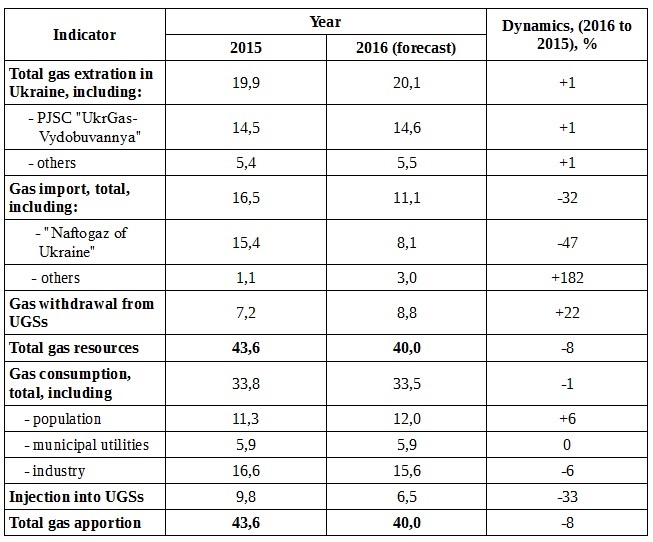
Sources: Ministry of Energy and Coal Industry, NAK "Naftogaz of Ukraine"
The most profitable and truly market segment, with annual consumption of 15.6 billion cubic meters of gas supplies to industrial consumers, "Naftogaz" shared almost equally last year with private companies-suppliers which took their gas resources (8.5 billion cubic meters) from production and imports. Relationships of all participants of this market segment with the consumers are based on solely contractual relations.
PSO and subventions — who feels well with them?
Fixed gas price, set by the government in 2016 (at least until April 1, 2017) for the population and municipal utilities, distributes "brotherly" the revenue from gas sales: 75% — for "Naftogaz", 17% — for budget, 7% — for gas-distributing companies and 1% is left for the suppliers of gas with public service obligations (PSO).
Another feature of this year's fixed gas price is that if in the summer it was approximately at a level of market prices then in December it was below market prices by about 1700 UAH.
Under these conditions, newly established companies-suppliers with PSO were not able to build up business — they simply didn't have money. During the entire year no new company even tried to show up on the "market" of gas supplies in the framework of PSO.
Even "Naftogaz" tried to limit its presence in the segment of PSO. "Naftogaz" avoided, almost up to November, signing contracts with and sale of gas to companies-suppliers for population. If the contracts would have had not be signed, the suppliers had to stop selling gas (it would be regarded as siphoning). And 13 million of household gas consumers would have had turned right to the "Naftogaz" as to a supplier of the last hope. To meet the "numerous requests", the monopolist, according to the existing network codes, would have had got the right to supply gas at a price that would have been 30% higher than was set by the Cabinet of Ministers. The CMU has not allowed that. Yet.
A separate issue is settlements on subsidies between participants of the gas market. The suppliers do not get real money in such settlements. Money transfers are arranged by Agreement Protocols. At the beginning of December it was revealed that in the chain of settlements there are more Protocols by 4 billion UAH than planned to be financed by the budget. "In the budget for December it was provided only UAH 4 billion for subsidies, but there were about UAH 8 billion in Protocols", — said a source in the Ministry of Finance.
At the same time, even with the deficit of finances to cover the Protocols, nobody takes off obligations of distribution companies to invest in the existing network. And to invest with real money. Because without money equipment for distribution points will not be sold.
2017: would be enough just to survive
The main event on the gas market is expected from April 1, 2017, when abandonment of regulated gas prices for population and municipal utilities is planned according to the plan of implementation of the provisions of the Law "On the natural gas market", and therefore, suppliers will receive an exemption from obligations under the PSO.
Taking into account the difference in gas prices and the purchasing power of population, up to 70% of which payments are carried out in some cases by the scheme of subsidies, the most realistic scenario may be the most pessimistic one:
— "Naftogaz" will focus on gas supply for industrial consumers;
— it will arise gas shortage for population and municipal utilities due to lack of providers which agree to work under conditions of low payment discipline and low liquidity of settlements by subsidies;
— uncontrolled growth of gas prices for population;
— imbalance of the gas market due to unpayments.
According to the participants of the gas market, in order to avoid the above consequences, it is necessary to prepare and implement such compensators:
— fix the maximum margin of 10% for suppliers of gas for population;
— partially monetize the subsidies. At the first step it is important to provide for that payments with "live" money under subsidies should be transfered not only to "UkrGasVydobuvannya", but also to private extraction companies;
— to approve typical contracts according to which the owners of the gas (including "Naftogaz of Ukraine") should supply gas for the needs of population and municipal utilities with delays of payments up to 90 days;
— to provide for responsibility of the state budget (interest) in case of delay in payments for subsidies.
The Vice-President of the European Commission, Commissioner on Energy Union Maroš Šefčovič during the high-level conference Ukraine—EU on energy partnership stated: "Implementation of the Third energy package by Ukraine is amazing, it happens even faster than in many member countries. As for gas market, all necessary laws have been already adopted here and now it is going work on regulations".
Šefčovič also welcomed the planned Ukraine's actions in this sphere: "For example, Ukraine plans in 2017 to create a market for gas trading on the day ahead".
"Of course, this does not mean that you have done everything. In particular, the government should implement the decision on separation of "Naftogaz" according to the adopted strategy," he added.
As for day ahead trading, it is likely that it will not be managed with only a few powerful computers and intelligent operators, as some managers of "Naftogas" mentioned before. The problem is in software. But the ten-der for its delivery have not even started. So, it is more desirable than a real "achievement".
"Ukrtransgaz" and the new operator of main gas pipelines
Despite the loud conflict with the change of the Statute of "Naftogaz" and the attempt of the Ministry of Economic Development and Trade to subordinate the operator the GTS — PJSC "Ukrtransgaz" - directly to the Ministry, on November 16 the Cabinet of Ministers approved the Statute of the new operator of the gas transportation system of Ukraine — PJSC "Main gas pipelines of Ukraine" (MGU). And while the special Commission headed by the Deputy Prime Minister Kistion looks into details, on November 14 the National Commission on securities and stock market registered the issue of shares upon establishment of PJSC "Main gas pipelines of Ukraine". The plan of restructuring "Naftogaz of Ukraine" was adopted by the government in accordance with the started in 2015 the reform of the gas market. "Naftogaz" has convinced the government that creation of a new independent operator of the GTS will provide the separation of activities of transportation of natural gas from activities of gas storage (injection, withdrawal). And that it is the implementation of Ukraine's commitments before the European Energy Community, taken within the framework of the Third energy package.
By that, special hopes have been put on Western investors - a partner for "Main Gas Pipelines of Ukraine", which should be interested in preserving the transit through Ukraine, which the Russians promise, if not fully stop, then reduce to the minimal level after expiration of the ten-year transit contract from January 2019. This, according to "Naftogas", accelerated the apply to arbitration in order to get compensation and for the possible halt of the transit before January 2019.
However, the new operator of the main gas pipelines will be able to start operation only after implementation of all decisions of the Stockholm arbitration, whatever they would be. "Naftogas", though, of course, is counting on its victory. Meanwhile, a new, but still inactive, operator "chooses" the most effective objects from the once-United GTS. The launch of its operation is scheduled on a third quarter of 2017, if at that time the court's decision would be executed. Meantime, oral hearings were held on two claims of "Naftogaz" to "Gazprom" for transit and procurement contracts from 2019.
UGSs and interconnectors
All operations on gas transportation, both for transit and for domestic consumers of Ukraine, are still carried out by PJSC "Ukrtransgaz". It operates also underground gas storages (UGSs), the most attractive of which will be included in another new operator - PJSC "Underground Gas Storage Facilities of Ukraine". But perhaps this will also be done only after the decision of the Stockholm arbitration.
However, "Ukrtransgas" has already signed agreements on the use of the Ukrainian UGSs. An important event was the signing in late November of contracts with companies Engie (France), Duf Energy Trading SA (Switzerland), and Trail Stone Energy LLC (Ukrainian office) for transportation and storage of gas in Ukrainian underground storage facilities. Before European traders sold gas at the border with Ukraine, but from next year they can start supplying gas to the internal market.
Ukrainian-Polish project is also moving further; it is included by the Europeans in the list of "projects of common interest" in October. This is the interconnector between Ukrainian and Polish gas transport systems. The pipeline with a length of about 100 km will link the gas transmission systems of both countries and open the possibility of free transportation of gas from Poland to Ukraine and vice versa. It is supposed to connect by this pipeline Ukrainian underground gas storages to gas corridor "North—South", which runs between the two Europian terminals for receiving liquefied natural gas (LNG terminals): in Polish Swinoujscie and on Croatian island Krk. The corridor "North—South" will go through Poland, Slovakia, Hungary and Croatia, and will allow the free movement of gas in Central and Eastern Europe.
The countries included in the corridor will connect their gas transportation systems by interconnectors - connecting pipelines. The pipeline "Ukraine—Poland" will be one more interconnector, with which the Ukrainian GTS will be included in the European gas transport "network". When this project is implemented, Ukraine will be able to get gas not only supplied, for example, from the USA through LNG terminals in Świnoujście or on the island of Krk, but also the gas that Poland will receive from Norway after the implementation of the project "North Gate".
In December, the operator of the Ukrainian GTS company "Ukrtransgas" already signed with Polish operator GAZ-SYSTEM S. A. the Agreement on the rules of interaction with the goal of integrating the transport systems of both countries through the future Interconnector.
After the construction of the gas pipeline, the capacity of gas transmission from Poland to Ukraine will amount to 8 billion cubic meters of gas a year (whereas today it is only 1.5 billion), and in the reverse direction — from Ukraine to Poland — 7 billion cubic meters per year. The sides push on implementation of this project as it will provide an opportunity for both countries to feel more confident on the gas market. Ukraine will be able to more actively pump into its underground storages gas purchased on the European market in the period of most favorable prices. In turn, Poland will be able to transport its gas to storages by the pipeline and keep it there. In addition, the construction of this pipeline will pave the way for gas transportation through Ukraine from Northern Europe to South and South-East Europe by the existing pipelines.
EC is our friend, but Russian gas is cheaper for Europeans?
Ukraine and Poland are forced to hurry up with construction of the Ukrainian-Polish interconnector because of "Gazprom's" intentions for construction of gas pipelines bypassing Ukraine. And something was achieved by "Gazprom". At the end of October, the European Commission withdrew the gas pipeline OPAL from the provisions of the Third energy package. This pipeline connects "Nord Stream" with the gas transmission system in Central and Western Europe. "Naftogaz" believes that this decision of the EC will allow "Gazprom" to connect the "Nord Stream" with gas transmission systems in Central and Western Europe bypassing Ukraine, that will lead to reduction of Russian gas transit through the territory of Ukraine by 10-11 billion cubic meters per year, and financial losses of at least 290-320 million dollars per year.
"Gazprom" managed to achieve some in another project that bypasses Ukraine. After a year of break up, relations between Russia and Turkey became warmer, and as a result the Turkish government ratified the project "Turkish Stream." This approval of the project by Turkey allowed the company South Stream Transport B. V. (subsidiary of "Gazprom") to conclude the contract with the Swiss company Allseas Group S. A. for laying the first leg under the Black sea. It is planned to supply to Turkey by first leg almost 16 billion cubic meters of gas, and by the second line of the same capacity, which will be built later, gas is planned to be delivered through Turkey in transit to Southern and South-Eastern Europe, taking away thus another part of transit from Ukraine. The head of "Gazprom" Alexey Miller said that the Russian company would fully finance the offshore part of the "Turkish stream", and "Gazprom" planned to complete construction of both lines of the pipeline before the end of 2019. This is a loud statement yet. But "Nord stream" was only a project at those times.
After "Gazprom" received the consent to the extended use of the OPAL gas pipeline and signed a contract for construction of "Turkish stream", Ukraine joins forces with Poland for abolition of the favourable for "Gazprom" decision of the EC on the OPAL gas pipeline. In particular, in early December the claim for cancellation of this decision was filed to the European court by the Polish company PGNiG. At that, PGNiG demanded to suspend and cancel the decision of the European Union and asked to make this decision before December 23rd, because at the end of the month the capacities of OPAL will be auctioned.
In addition, Polish PGNiG and Naftogaz also filed a complaint in respect of the OPAL gas pipeline against the German regulator in the energy sector, the Bundesnetzagentur. "Naftogaz" indicates numerous negative consequences of the decision on the OPAL for Ukraine. Among them — the cessation of gas flows from Poland, the decrease in volumes of natural gas transit through Ukrainian GTS, and significant reduction of transit revenues of "Naftogaz". In addition, the decision on the OPAL will lead to increased costs for purchase and transportation of natural gas to Ukraine, to risks for balancing the volumes of natural gas within the country and additional expenses for technical optimization of the Ukrainian GTS and underground gas storage facilities, associated with the transition to a new mode of operation, different from the existing one.
Poland has already declared that does not intend to stop half-way and plans "the next legal steps" in the sphere of appealing the decision on OPAL. In addition, as noted by "Naftogaz", the decision on the OPAL will affect not only Ukraine and Poland. As a result of this decision, "Gazprom" will be able to abuse its dominant position on the markets of Germany, Slovakia, and other countries of Central and Eastern Europe. Most likely, "Naftogaz" is now actively seeking for allies in future disputes, since the company does not exclude that the decision of the German regulator and the European Commission will be also appealed by other participants of the European gas market.
It is therefore not surprising that, against the background of the above mentioned, "Gazprom" does not want to negotiate any additional agreements or another so-called winter package. But "Gazprom" is only escalating the situation, achieving tractability of the EC. We hope that it will not come to the next "freezing" of uncompromising Europe, as it was in 2006 and 2009. With this we will celebrate the New year.
However, apparently, "Gazprom" has overreached itself. "On December 23, 2016 the EU Court suspended the decision of the European Commission about access of "Gazprom" to the OPAL pipeline that is one of the branches of the Russian "Nord stream", — said the General Director of the Polish gas company PGNiG Piotr Wozniak, as reported by Bloomberg. The court's decision must be published before the end of this year.
According to the Director of the Polish PGNiG, the EU Court has suspended the decision of the European Commission about increasing the access of "Gazprom" to the OPAL pipeline.
Meanwhile, "Gazprom" has already increased physical download of OPAL to 86%. As previously reported, Poland and Ukraine appealed to the European court to challenge the decision of the European Commission on the extended access of the Russian "Gazprom" to the German gas pipeline OPAL. The foreign Ministries of both countries believed that the decision of the EC would make it dependent on Russia and threaten security of gas supplies in Central and Eastern Europe.
Though, it is not the fact that "Gazprom" will not appeal this decision. But the decision of the EU Court is pleasant news by the New year for us, for our neighbors, especially Poles, as well as for many Central and Eastern European countries.
Original article can be found here:
in Ukrainian - http://gazeta.dt.ua/energy_market/pro-naftu-pro-gaz-zachatki-rinku-ta-pro-nas-_.html
in Russian - http://gazeta.zn.ua/energy_market/pro-neft-pro-gaz-zachatki-rynka-i-pro-nas-_.html


